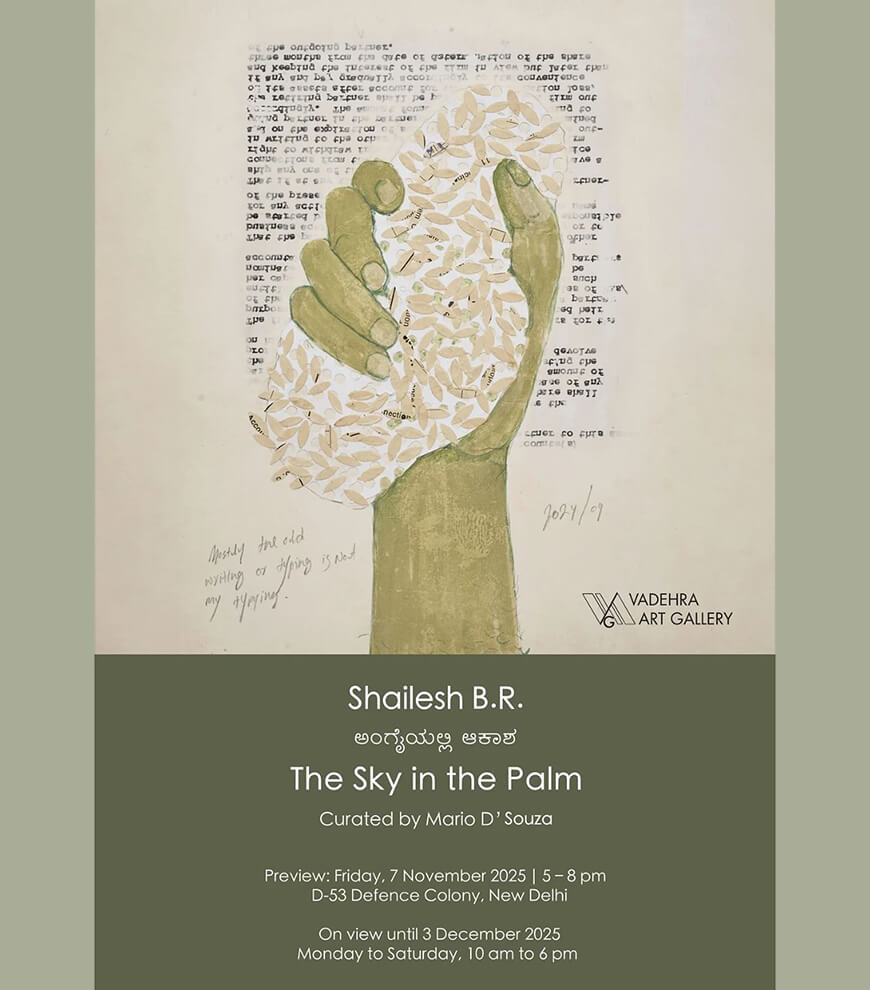
Shailesh B.R.: The Sky in the Palm
Vadehra Art Gallery, New Delhi, presents “The Sky in the Palm,” a solo exhibition by artist Shailesh B.R., curated by Mario D’Souza — who is also part of the curatorial team for the forthcoming 6th edition of the Kochi–Muziris Biennale. Opening on 7 November 2025, this exhibition unfolds as a poetic and philosophical meditation on the intersections of machine, myth, and metaphysics, offering audiences a rare insight into the artist’s inventive and performative approach to sculpture and object-making.
Over the years, Shailesh B.R. has developed a distinct body of work that straddles mechanical engineering and metaphysical inquiry. His art often transforms rudimentary mechanisms into contemplative instruments that probe the human condition, emotion, and transcendence. “The Sky in the Palm” brings this practice to a deeply introspective culmination — a space where automation and imagination coalesce.
The title itself evokes a paradox — how can one hold the sky in the palm? This poetic contradiction becomes central to Shailesh’s method. His works operate within that impossible space — a space where logic meets belief, where the mechanical meets the meditative. In this exhibition, his creations — part sculpture, part kinetic machine — inhabit the threshold between ritual and robotics. These works appear as extensions of both the human hand and the divine gesture, suggesting that the act of creation lies somewhere between invention and prayer.
Shailesh’s practice is rooted in the traditions of craft and mechanical curiosity, yet he situates these within contemporary discourse — addressing ideas of automation, agency, and the “post-human” self. In “The Sky in the Palm,” his machines invite viewers to witness movement not merely as motion but as a form of thought. Each object becomes a vessel of imagination — a reminder that machines, too, can dream.
The curatorial vision by Mario D’Souza frames this exhibition as an exploration of “mechanical metaphysics.” It challenges conventional binaries between science and spirituality, asking: Can an automated object possess sentience or spirit? Shailesh’s works answer not through assertion but through quiet play — through the hum of a motor, the spin of a wheel, or the turn of a crank that animates the stillness of clay, metal, and wood.
In an era defined by artificial intelligence and machine learning, Shailesh’s art reclaims technology as an emotional, almost sacred field of experience. His machines do not simulate humanity; rather, they reveal its essence — the urge to understand, to connect, and to create meaning in motion. The exhibition’s conceptual depth lies in its ability to translate these complex ideas into tangible, tactile forms that pulse with quiet vitality.
The exhibition also pays homage to Shailesh’s ongoing engagement with performance, language, and gesture. Many of his works, though sculptural, carry traces of performative action — as if they have been used, touched, or activated in ritual. This lends them an anthropological aura, connecting the mechanical to the ancestral. His works might resemble scientific prototypes, but their poetry lies in the imperfection of handcraft — a reminder that every mechanism begins with a human impulse.
“The Sky in the Palm” ultimately becomes a metaphor for the artist’s world — one where the tactile, the technological, and the transcendental coexist. It is an exhibition that doesn’t simply present objects, but orchestrates an experience — of balance, rhythm, and wonder.
As Shailesh writes in one of his notes: “Mostly, the old writing or typing is not my thinking.” The line, scribbled near one of his drawings, reflects his enduring fascination with language, tools, and their unintended poetry. In his hands, the typewriter, the wheel, or the motor are not machines but storytellers — each carrying the sky within their palm.