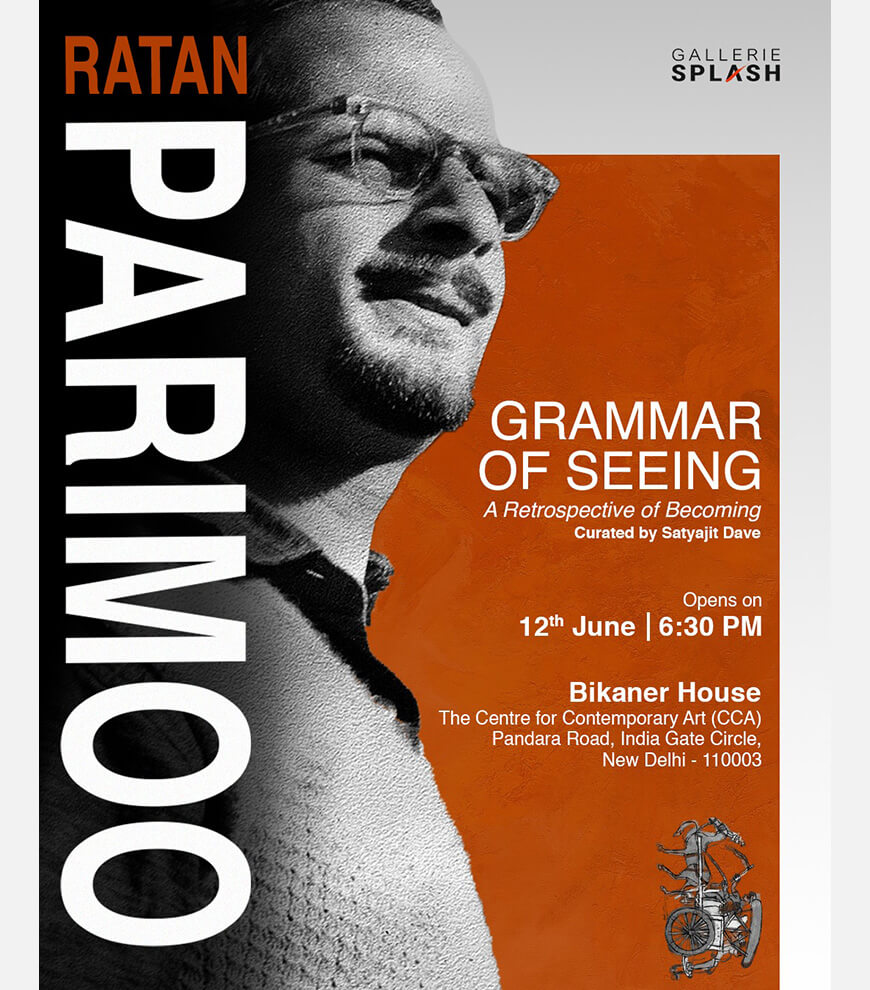
Ratan Parimoo: Grammar of Seeing
Gallerie Splash is delighted to present Grammar of Seeing, a solo exhibition of the abstract phase of Ratan Parimoo, curated by Satyajit Dave. This exhibition will be on view from 12th June to 16th June 2026 at Bikaner House, The Centre for Contemporary Art, New Delhi. It is a major retrospective exhibition that brings together an extensive selection of paintings, prints, drawings, collages, and works on paper by noted artist and art historian Ratan Parimoo. Spanning several decades of artistic practice, the exhibition also includes a rich archive of photographs, letters, personal correspondences, and writings by the artist, offering audiences a rare insight into both his creative process and intellectual world.
Conceived as an exploration of process as much as practice, the exhibition traces the evolution of Parimoo’s visual language from his early academic studies to his mature abstract works. Rather than presenting abstraction as a break from representation, the retrospective reveals a continuous dialogue between observation, discipline, and experimentation. Early life studies, sketches, and college works demonstrate the artist’s rigorous engagement with contour, structure, rhythm, and spatial relationships—foundations that later informed his highly personal abstract vocabulary.
Across the exhibition, viewers encounter an artist deeply invested in the possibilities of form. Through ink works, collages, prints, and chromatic abstractions, Parimoo explores the balance between order and spontaneity, structure and improvisation. Line, gesture, color, and repetition become tools through which visual meaning is constructed and transformed. The exhibition highlights how his practice evolved not through rupture, but through sustained inquiry and refinement.
A significant aspect of Grammar of Seeing is its emphasis on the archive as an active part of artistic practice. Letters, photographs, and writings are presented alongside artworks not as supplementary material, but as integral elements that illuminate Parimoo’s reflections, relationships, pedagogy, and modes of thinking. Together, the works and archival material offer a fuller understanding of the artist’s legacy—one shaped equally by making, teaching, observing, and recording.
By bringing together artworks and documents within a single curatorial framework, the exhibition invites audiences to move between image and memory, object and text, process and finished form. Grammar of Seeing ultimately presents Ratan Parimoo as an artist for whom art was inseparable from ways of seeing and understanding the world, offering a profound insight into the formation of an artistic consciousness across time.
More than a retrospective, Grammar of Seeing stands as a testament to a lifetime devoted to observation, inquiry, and the endless transformation of seeing into art.
About the Artist
Born in 1936 in Srinagar, Kashmir, Ratan Parimoo is one of India’s leading art historians as well as an accomplished painter and teacher. Beyond his post at M.S. University, Baroda, as a professor of Art History and Aesthetics and the dean of the department for twenty-five years, Parimoo has been shaping modern art discourse in the country since he was a young man. In 1956, he co-founded the Baroda Group of Artists with peers including G.R. Santosh, K.G. Subramanyan, Shanti Dave, N.S. Bendre, and Jyoti Bhatt, to expand on the postcolonial aesthetics piloted in Santiniketan the previous decade and evolve the meaning of contemporary art in India by integrating living traditions with modern
techniques.
He was the head of the Department of Art History and Aesthetics at the M.S. University (1966-91) and carried through his tenure a vision of the discipline as being at the juncture of many allied but somewhat alienated fields. His training in painting and emphasis on the inter-relationship of the arts, history, theories and research made his teaching unparalleled.
Note from the Curator:
Ratan Parimoo: Grammar of Seeing, A Retrospective of Becoming presents a major reassessment of one of the most intellectually rigorous yet under-recognized figures of Indian modernism. Staged across the CCA building at Bikaner House, the exhibition traces Parimoo’s movement from early figurative, landscape, academic, and Kashmir-related works of the 1950s to an independent and materially ambitious language of abstraction that developed from the mid 1950s through 1980.
The exhibition unfolds through three interrelated sections: The Observed World, Between Memory and Method, and Abstraction Becomes Language. Together, they reconstruct the process by which Parimoo’s abstraction emerged through observation, perceptual memory, formal training, pedagogy, material knowledge, and surface.
On the ground floor, early Kashmir landscapes, portraits, life studies, student exercises, and ink drawings reveal an artist working through parallel practices. On one hand, Parimoo produced academic works in which the line remained highly trained and rooted in observational discipline. On the other hand, he was already making images in which line began to move independently, colour became expressive rather than descriptive, and space compressed into formal structure. Kashmir is not treated here as nostalgia, but as perceptual memory: a field of visual essences, rhythms, planes, bridges, boats, façades, and spatial tensions that Parimoo gradually transformed into abstraction.
The middle movement of the exhibition foregrounds Baroda as the decisive site of formation. N.S. Bendre’s impact on Parimoo is presented not as simple stylistic influence, but as a pedagogic lineage. Bendre taught through demonstration, through the act of making form appear before students. His ability to create what Parimoo would later understand as a kind of “magic on paper” becomes central to the exhibition’s reading of method, process, and visual discipline.
The first floor follows abstraction as it becomes Parimoo’s language. Works from approximately 1955 or 1956 to 1980 show an artist developing a vocabulary of surface, sign, configuration, collage, materiality, and pictorial tension. Of particular importance is Parimoo’s early experimentation with materials such as sand, pigment, glue, pebbles, and textured matter. Connected to his training in museology, these works suggest a technically informed approach to abstraction in which painting becomes not merely an image, but an object of surface, matter, and force. The exhibition proposes that this chronology invites renewed attention to Parimoo’s pioneering role in the material history of Indian abstraction.
Bringing together artworks, student records, credit score cards, Baroda Group material, letters, exhibition invitations, catalogues, price lists, photographs, Courtauld documents, lecture notices, and international correspondence, Grammar of Seeing: A Retrospective of Becoming positions Parimoo within a dense network of artistic and intellectual exchange. His proximity to figures and institutions such as N. S. Bendre, Jyoti Bhatt, Gulammohammed Sheikh, Shanti Dave, Naina Dalal, Mulk Raj Anand, Patwant Singh, the Courtauld Institute, the Museum Society of Bombay, the JDR III Fund, MIT, Berkeley, and Baroda’s Faculty of Fine Arts situates him within both Indian and global histories of modernism.
This retrospective is therefore not only a return to an artist’s career. It is a corrective act of looking. It asks viewers, scholars, institutions, and collectors to reconsider Parimoo as a pioneering artist scholar whose work expands the history of Indian abstraction through memory, method, material intelligence, and a disciplined grammar of seeing.
– Satyajit Dave
June 2026