Naturing Nature: A Group Exhibition Curated by Yamini Telkar
Naturing Nature: When Nature Reclaims Its Place Within the City
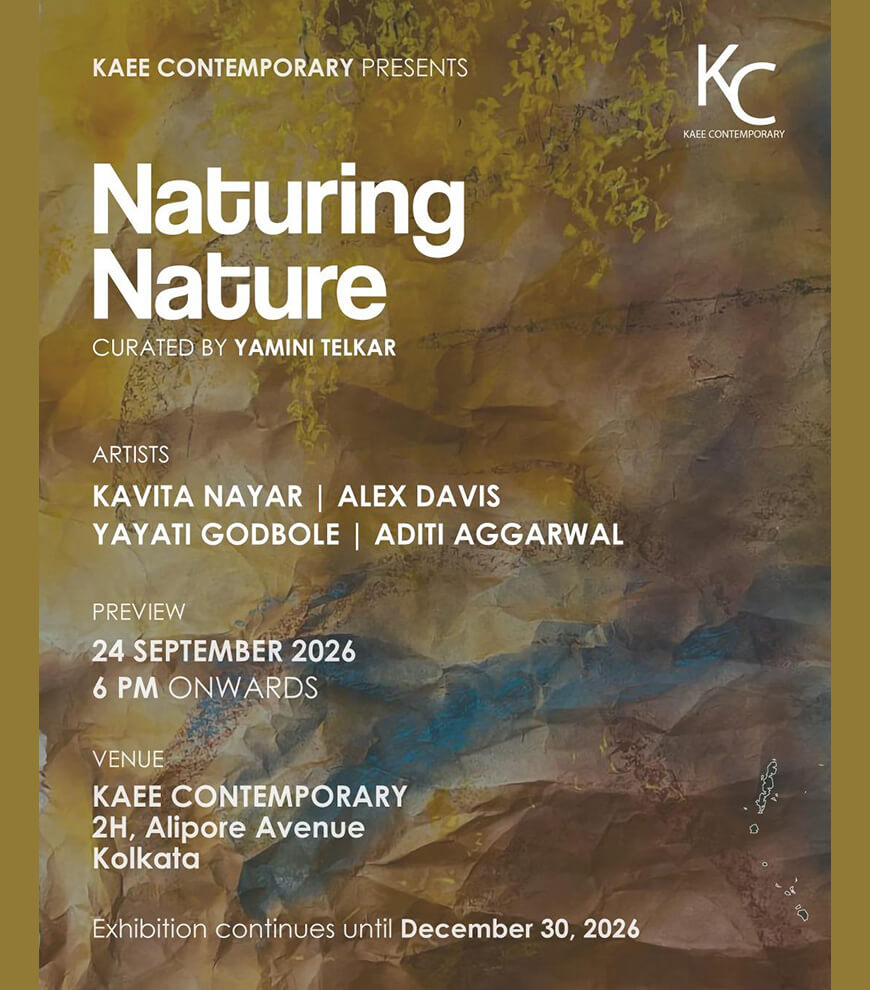
Artists: Kavita Nayar, Alex Davis, Yayati Godbole and Aditi Aggarwal
Curated by: Yamini Telkar
What happens when nature is understood not simply as a landscape, subject or backdrop, but as a living process—one that constantly changes, adapts, resists and finds ways to reclaim its presence?
Naturing Nature, a group exhibition curated by Yamini Telkar, brings together the practices of Kavita Nayar, Alex Davis, Yayati Godbole and Aditi Aggarwal at Kaee Contemporary, Kolkata. The exhibition opens with a preview on 24 September 2026 at 6 PM and continues through 30 December 2026.
Presented as a collateral exhibition of the upcoming Bengal Biennale, Naturing Nature approaches nature as an active and evolving presence within contemporary life. Rather than positioning the natural world as something separate from human existence, the exhibition considers the ways in which organic forms, ecological memories, material processes and urban environments continuously intersect.
The exhibition also emerges from conversations and artistic exchanges connected to Art Ichol, Ambica Beri’s creative retreat in Ichol near Maihar, Madhya Pradesh. Conceived as a space for artists, writers and creative practitioners to work and exchange ideas amid an open natural environment, Art Ichol has developed a strong relationship between artistic practice, landscape, community and creative experimentation.
Nature as Process
The title Naturing Nature suggests a movement rather than a fixed state. Nature is continually becoming: growing, decomposing, adapting, transforming and returning. Within the context of the exhibition, this idea opens up a broader reflection on how contemporary artistic practices can engage with ecological consciousness without reducing nature to an illustrative subject.
The works brought together by Telkar can be viewed through this larger conversation between organic and constructed environments, natural rhythms and human intervention, memory and materiality.
This approach also resonates with the larger ecological orientation of Kaee Contemporary itself. The gallery describes “Kaee” as a colloquial word for algae—an organism associated with ecological vitality, nourishment and filtration. Founded by Ambica Beri in 2022, Kaee Contemporary positions itself within Kolkata’s contemporary art ecology, with an emphasis on emerging and experimental practices and dialogue between urban and rural perspectives.
Four Artistic Perspectives
Kavita Nayar, one of the participating artists, brings a practice rooted strongly in printmaking while extending across painting and other media. Born in 1957, Nayar studied at Kala Bhavana, Santiniketan, and the College of Art, New Delhi. Her work has engaged with printmaking as well as oil, acrylic, pastel and watercolour, and has been exhibited internationally. Recent works listed by Sameksha include Murmuring, Whispering, Liberated and Transcending, reflecting her continuing exploration across materials and visual language.
Alex Davis approaches nature through sculpture, design, material and scale. A contemporary Indian sculptor, artist and designer, Davis studied Mechanical Engineering before pursuing Product Design at NID Ahmedabad and Industrial Design at Domus Academy in Milan. His practice frequently draws upon flora, fauna, everyday Indian life and vernacular visual culture. Works from series such as My Lazy Forest, Hyper Blooms and Herbarium Indicum demonstrate his sustained engagement with botanical and natural forms, often reinterpreting them through industrial materials and contemporary scale.
Aditi Aggarwal works across painting, bookmaking, collage and alternative photographic processes. Her practice investigates layered experiences of contemporary life, overlapping temporalities, urban fragmentation and ecological memory. She describes time not merely as a backdrop but as a material and method within her work, using processes of layering, erasure and repetition. Her practice therefore offers another way of considering nature—not only as an external environment but also as something remembered, accumulated and experienced through time.
The exhibition also features Yayati Godbole, adding another artistic voice to this four-person conversation. Together, the four practices create an opportunity to consider the many ways artists can approach the natural world—from botanical and ecological forms to questions of material, memory, time and the relationship between human-made and organic environments.
From Maihar to Kolkata
One of the distinctive aspects of Naturing Nature is the dialogue between different environments. The exhibition’s connection with Art Ichol is significant in this context. Located near Maihar in Madhya Pradesh, Art Ichol was conceived by Ambica Beri as a creative space where artists and other practitioners can work under open skies and engage with an environment that encourages collaboration and experimentation. Its facilities include studios, an open-air sculpture park and spaces for residencies and artistic exchange.
The movement from such a rural and immersive setting into Kolkata’s urban landscape creates an interesting framework for the exhibition. Nature here is not necessarily something distant from the city; instead, it can be understood through fragments, memories, materials, forms and traces that continue to exist within urban life.
This conversation becomes particularly timely as Kolkata prepares for the second edition of the Bengal Biennale, scheduled for late November 2026 through early January 2027. The official Bengal Biennale website describes its 2026–27 edition as exploring Banalata and connections between subterranean worlds, buried histories, ecological relationships and the city of Kolkata and Santiniketan.
Looking at Nature Differently
Rather than treating nature as a fixed category, Naturing Nature invites viewers to consider it as something constantly in formation. The exhibition brings together different artistic approaches to ask how natural and human environments overlap, and how artistic processes can make those relationships visible.
At a time when cities continue to expand and ecological questions increasingly shape everyday life, the exhibition offers a space for slowing down and observing these intersections.
Through four distinct practices, Naturing Nature opens a conversation around landscape, ecology, materiality, memory and transformation—and asks us to reconsider where nature ends and the constructed world begins.