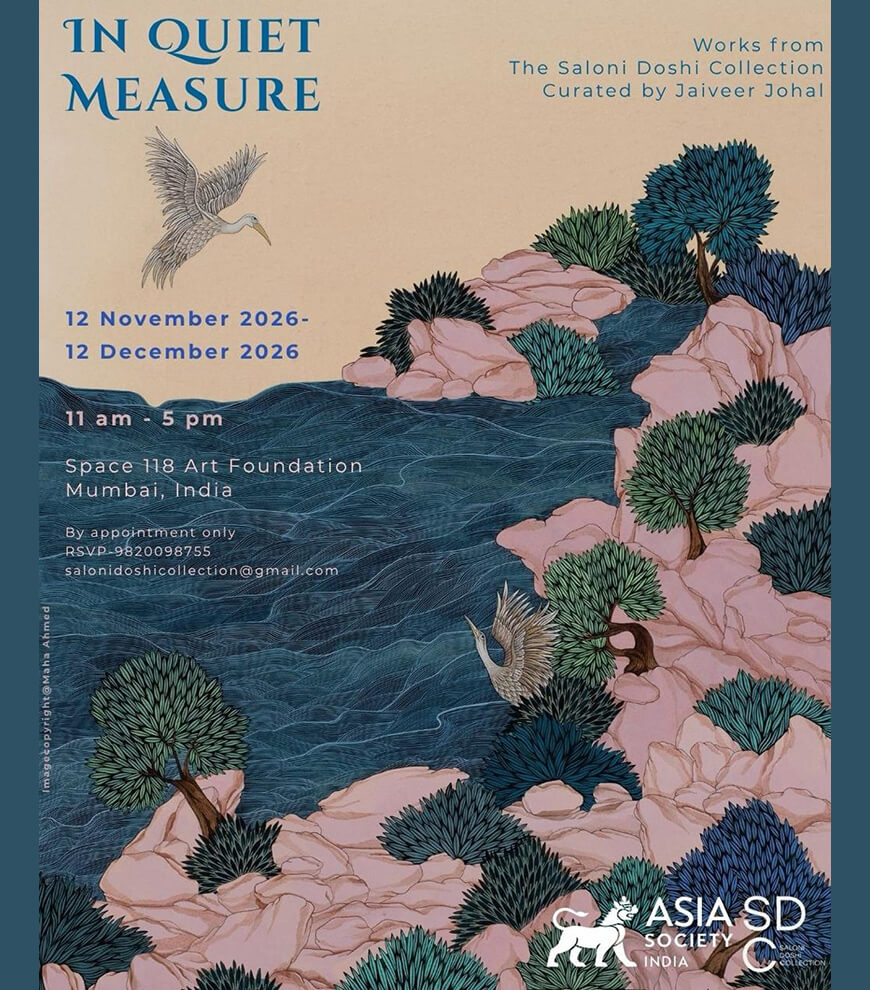
IN QUIET MEASURE: Works from the Saloni Doshi Collection, Curated by Jaiveer Johal
Looking Beyond the Visible: The Many Possibilities of Figuration
What does it mean to represent the human figure? Is the body simply a physical presence within an artwork, or can it become a site where memory, identity, emotion, conflict and personal history take shape? These questions form the conceptual foundation of IN QUIET MEASURE, an exhibition presenting figurative works from the Saloni Doshi Collection, curated by Jaiveer Johal at Space118 Art Foundation, Mumbai.
Presented by the Saloni Doshi Collection in collaboration with Asia Society India Centre, the exhibition brings together works by artists who approach figuration through a wide range of artistic languages and sensibilities. Moving beyond conventional representation, the exhibition considers the human and animal figure, along with the recognisable world surrounding them, as a starting point for exploring the psychological, emotional and social dimensions of lived experience.
Built through years of collecting, the Saloni Doshi Collection encompasses a diverse range of modern and contemporary Indian and South Asian art. Its holdings extend across painting, photography, sculpture, textiles and mixed media. IN QUIET MEASURE brings a particular dimension of this collection into focus: the enduring possibilities of figurative art and its capacity to reveal what lies beneath the surface of visible forms.
Figuration as a Language of Experience
The exhibition approaches figuration not merely as the depiction of a recognisable body, but as a language through which artists examine the complexities of human existence. A figure may appear in its entirety, be distorted or fragmented, emerge through a few suggestive lines, or almost dissolve into its surroundings. Yet even when representation becomes uncertain, the presence of the body continues to hold meaning.
As curator Jaiveer Johal explains in his curatorial note, he has long been interested in the point at which the body is pushed to the edges of recognition through distortion, exaggeration, fragmentation or dissolution, while remaining within the realm of figuration. The works in the collection reflect this expansive understanding of the figure, ranging from restrained and intimate expressions to compositions marked by excess, collision and psychological intensity.
The exhibition therefore invites viewers to look closely at gesture, posture, expression and the spaces inhabited by bodies. These visual elements become carriers of memory, identity, intimacy, conflict and emotion. The figure is not simply an object to be observed; it becomes a means of understanding the relationship between the individual and the world.
The Curatorial Journey: From the Inner World to the World Beyond
Johal has conceived the exhibition as a journey through different dimensions of figuration. Rather than arranging the works around a single theme, the curatorial approach moves between the external world and interior thought, the material self and the surrounding landscape, eventually arriving at the intimacy of objects and private encounters.
The exhibition unfolds through six spaces, each offering a distinct perspective on the body and its relationship with the world:
- Studio 1: Inner World – An exploration of inwardness, personal reflection and the psychological dimensions of the figure.
- Studio 2: Stress and the Mind in Conflict – Works engaging with tension, memory, conflict and the emotional complexities of experience.
- Studio 3: Flesh and Form – An examination of the material body and the possibilities of its representation.
- Studio 4: Beyond the Body – A movement beyond the human figure towards broader questions of existence and the world beyond the self.
- Studio 5: Reimagining the Miniature – A consideration of scale, detail and the visual possibilities of miniature traditions.
- Studio 6: Saloni’s Room – A concluding space that brings the journey back to the collector and the personal history of the collection.
This progression encourages viewers to reconsider the relationship between the figure and its surroundings. Landscape, architecture, objects and empty spaces are not merely backgrounds; they participate in shaping how a body appears, moves, is perceived and acquires meaning.
Artists and Diverse Approaches to the Figure
The exhibition brings together established and emerging voices from contemporary Indian art. Among the artists represented are Atul Dodiya, Anju Dodiya, Jitish Kallat, Khadim Ali, T. Venkanna, Anupam Sud, Nityan Unnikrishnan, Kulpreet Singh, Aditya Pande, Karishma D’Souza and Utkarsh Shakya, alongside several other practitioners.
Their works demonstrate how figuration can accommodate radically different artistic approaches. Some artists engage with recognisable bodies and intimate psychological spaces; others employ fragmentation, distortion, abstraction or intricate visual narratives to suggest experiences that cannot be expressed through straightforward representation.
Among the works discussed in coverage of the exhibition are Anju Dodiya’s Studio Guests (1998), which draws upon the visual language of Company School painting, and Jitish Kallat’s Traumanama (The Cry of the Gland). Other exhibited works include Utkarsh Shakya’s Divided Priorities, as well as works by Atul Dodiya, T. Venkanna and several other artists.
The diversity of these practices makes the exhibition less a survey of one particular style than an exploration of the possibilities of representation itself.
The Spaces Around the Body
An important aspect of Johal’s curatorial approach is his attention to what exists around the figure. The body does not exist in isolation. Its meaning is shaped by the landscape it occupies, the architecture that surrounds it, the objects it encounters and even the emptiness that separates it from other forms.
These relationships expand the scope of figuration. A figure can become part of a broader social narrative, carry the weight of personal or collective history, or suggest a psychological state through its relationship with its surroundings.
Johal also invites viewers to consider the body as a site of personal and political history, one that may be shaped by social expectations, conflict and control, but is equally capable of expressing pleasure, immediacy and wonder. In this understanding, figuration becomes a way of reflecting on what it means to inhabit a body and experience the world through it.
The Saloni Doshi Collection: A Continuing Public Conversation
For Saloni Doshi, the exhibition represents another opportunity to make a private collection accessible to a wider audience. Over the years, the collection has developed through encounters with artists and artworks, personal interests and an evolving engagement with modern and contemporary art.
The Saloni Doshi Collection has previously presented exhibitions exploring photography, textiles, sculpture and abstraction. These include The Right to Look, The Woven Path, Sculpting Air and The Presence of Absence. Each presentation has brought a different aspect of the collection into public view through the perspectives of invited curators.
IN QUIET MEASURE continues this process of looking at a collection through a fresh curatorial perspective. By inviting fellow collector Jaiveer Johal to interpret the works, Doshi creates an opportunity for new connections to emerge between artworks that have been gathered over many years.
The exhibition is described by India Art Fair as the final presentation in this public exhibition series. Rather than simply bringing the series to a close, it offers an occasion to reflect on the relationships, ideas and artistic conversations that have developed through the collection’s public presentations.
An Invitation to Look Again
At a time when contemporary art continues to expand into digital, technological and increasingly post-human territories, IN QUIET MEASURE returns attention to the figure and the possibilities that remain within its representation.
The exhibition asks viewers to look beyond the immediate appearance of a body and consider the histories, emotions, memories and relationships it may contain. Through a diverse selection of figurative works, it reveals how familiar forms can continue to surprise, unsettle and provoke new ways of seeing.
Bringing together the vision of collector Saloni Doshi and the curatorial perspective of Jaiveer Johal, IN QUIET MEASURE offers an opportunity to engage with contemporary Indian art through the enduring language of figuration.
The exhibition is on view at Space118 Art Foundation, Mumbai, until 12 December 2026. To schedule your visit, please write to salonidoshicollection@gmail.com or call +91 98200 98755.