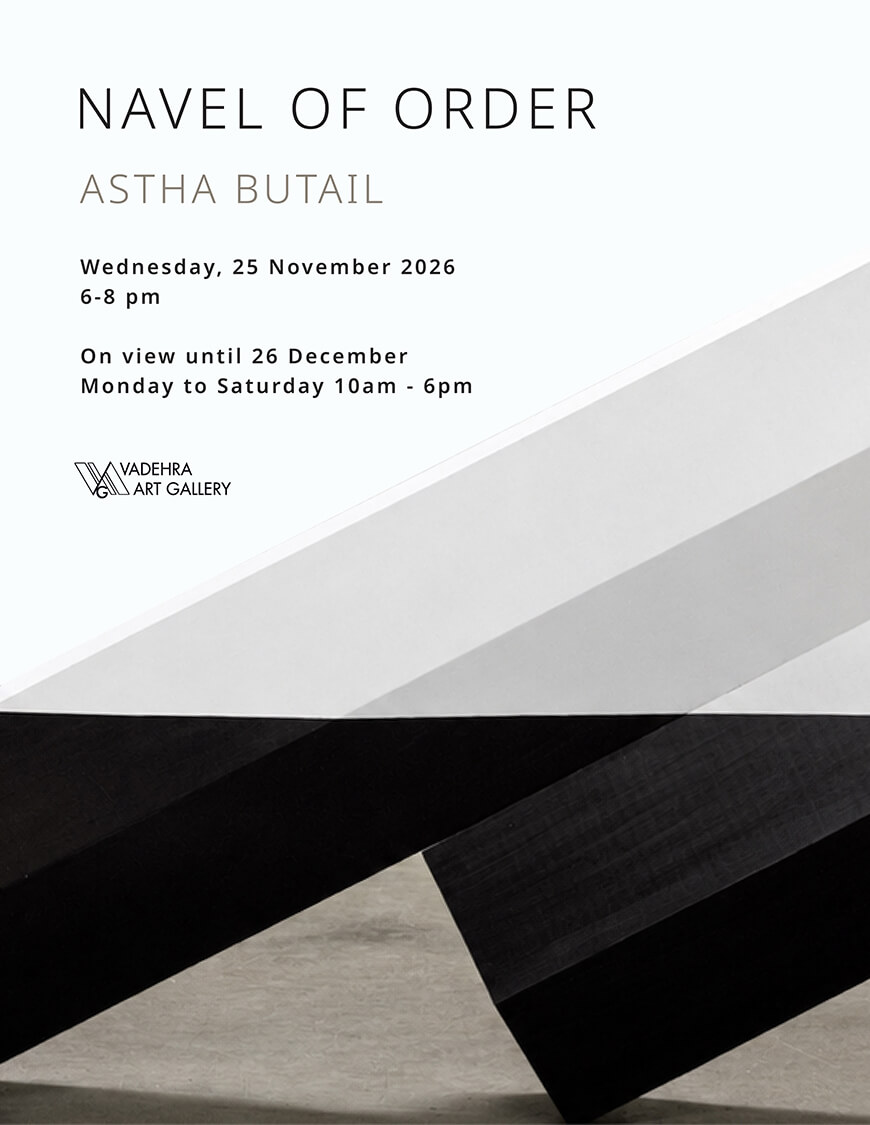
Vadehra Art Gallery presents Navel of Order: A solo Exhibition by Astha Butail
Vadehra Art Gallery presents a solo exhibition by Delhi-based interdisciplinary artist Astha Butail. Titled Navel of Order, the exhibition brings together a new and recent body of mixed-media works, including installations and sculptures alongside an interactive participatory project that invites viewers to contribute to the artist’s evolving archive. The exhibition opens at the gallery’s D-53 Defence Colony space in New Delhi on 25 November and will be on view until 26 December 2026.
In Navel of Order, Astha Butail explores Ritam, an ancient Sanskrit term from the Vedic tradition meaning cosmic order, or that which gives everything its place and its motion (ritu). The exhibition takes its title from the Vedic understanding of the navel (nabhi) as the physical physical, energetic, and cosmic centre of existence. It represents the point of origin, sustenance, and connection between the individual human body and the wider universe.
Reflecting on a world marked by conflict, disorder, unrighteousness and deceit, absorbing issues like genocide, rape, conflict, and the killing of systems and ecosystems, Butail considers how this underlying Ritam is being disturbed. There is ‘an-ritam’, the degradation and a sort of dying of values and faith.
Her choice of title, rather than one that foregrounds disorder, reflects a conscious shift in perspective: an attempt to locate the possibility of continuity amid conditions of profound instability.
In the large-scale installation titled Muted World (2026), Butail presents a collapsed roof sculptural intervention crafted according to the memory and recitation patterns of the Rig Veda that also carries a strong feeling of collectively needing to start over. She uses slate, a material brought from her village in Kangra, Himachal Pradesh, which was used to make the roofs of houses but in time is being replaced with cement. In the nineteenth century, slate was also widely used as a writing surface particularly in schools and classrooms and also homes and businesses; its near-obsolete status given the rapid rise in technology speaks to the threat of extinction that oral traditions also face in the modern world.
Butail’s practice moves between textile, painting, drawing, video, sculpture and installation, often using materials like thread, brass, paper, slate and wood. She draws inspiration from literature, poetry, orality, culture, self-help, spirituality and nature. She uses the idea of collective authorship to create installations not knowing the exact and final outcome of such projects, and thus becomes a facilitator where the participations of the spectators become the process of making. For Butail, traditions offer more than historical or religious references; they provide ways of understanding the principles through which human life and the natural world unfold. Her use of recurring patterns, geometric structures and carefully sequenced elements draws on the cadence of chanting, recitation and incantation, where repetition creates musicality and rhythm reflecting how knowledge is preserved and transmitted across generations.
Artist Note
In Vedic and Philological Studies Sri Aurobindo (1872–1950) writes about Ritam:
‘Ritam is Truth, Law, that which is straight, upright, direct, rectum; it is that which gives everything its place and its motion (ritu), that which constitutes reason (ratio) in mind and rectitude in morals. It is the rightness or righteousness which makes the stars move in their orbits, the seasons occur in their order, thought and speech move towards truth, trees grow according to their seed, animals act according to their species and nature, and man walk on his prescribed path.’
I am inspired by these words and feel them with each passing day as I hear and read the news across absorbing issues like genocide, rape, conflict, and the killing of systems and ecosystems. I clearly see a world living in a constant flux of disorder, unrighteousness and deceit. It is like the opposite of Ritam, ‘an-ritam’, the degradation and death or a sort of dying of values and faith.
I feel the NAVEL OF ORDER of the world is disturbed and is falling apart. The navel marks the geometric centre of the abdomen and the intersection point where the four abdominal quadrants meet. In the Vedic tradition, the navel (nabhi) is viewed as the physical, energetic, and cosmic centre of existence. It represents the point of origin, sustenance and connection between the individual human body and the wider universe.
In these present times, I feel the pressure of a collapsed roof. In the work Muted World (2026), a collapsed roof sculptural intervention, the feeling that we will have to start all over again is very strong. We as a human race will be or perhaps have already been muted. I choose to call the show ‘Navel of Order’ and not ‘Navel of Disorder’ as I approach this from a positive vantage point. The Unborn series carries references from the Rig Veda of clothing as symbols of casting oneself into a mechanism; Vastr (clothing in Sanskrit), from the word ‘vaas’, means to reside and dwell. The act of wearing, inhabiting and containing, filling something in, the repetitive square pattern and the cross of warp and weft, the interplay of Purush and Prakriti in the role of creation, tucked inside the womb, untouched, waiting to erupt hidden, covered layer by layer, lie flat made with cotton breathable yardage dhoti bringing us nearer to the journey of the arrival.
The light boxes (In a flux of hope and There is enough room for everything) instil a capacity of drawing upon a superior energy of order and freedom. The sculptural work RituChakra (Six Seasons’ Matrix) (2026) reflects a peaceful flow of slow, seasonal transition between Grishma (summer), Varsha (monsoon), Sharad (autumn), Hemanta (pre-winter), Shishira (deep winter) and Vasanth (spring), expressed in a form of six, chair-like sculptures connected with thread. Thread for me is a metaphor of Ritam, of the value of inter-connectedness, of its humility, the relation between the parts versus the whole. Each moment he rose there was a larger poise was a meditation while making the work. The hand drawings with archival pen, the square growing with each triangular frame, were a function of increase in the consciousness and a symbol of change.
The ‘ri’ in Ritam (ṛtam / ऋतम्) comes from the foundational verbal root ṛ (ऋ), which means to move, to go, to flow or to rise. On the ground floor, seven sculptures sit quietly close to one another with the interplay of black–and–white energy; for me, they represent the act of bending forward or backward, where the spine moves and freezes at a point such that balance is somehow maintained. The equilibrium is hit. Each of the seven twin sculptures moves at a different angle as if the white pouring into the black maintains a unique balance within themselves. They are still but appear as if moving. This work titled Of Movement, Questions to Self poses the question of the stages of one’s own life, the relationship one has with one’s own self at different ages.
The ground floor is filled with the interplay of the black and white or white and black; in a monotone, all together sit strongly telling the same story of the Black Sun in different forms. Book of Night and We All Mortals spring from the Black Sun, a painful strength, invisible anti-sun, a forced source of energy, a shadow of spiritual light. The Book of Night is an open-book work with slate and white and wooden frames speaking about the end of the day and entering the night (ratri); a metaphor not of literal darkness, but as a profound psychological and cosmic symbol. Rather than viewing Night as evil or empty, I learn to see it as a creative womb within the eternal rhythm of Ritam – the cosmic order that holds both endings and beginnings. Finally, I invite you in the work We All Mortals, an interactive library and archive in process about the notions of death, often the moments not lived fully or facing physical death. Did it push life in a direction of greater strength?
– Astha Butail
About the Artist
Born in 1977 in Amritsar, Punjab, Astha Butail completed a master’s degree in economics from Punjab University, Chandigarh; a master’s in the Rig Veda from the Gnostic Centre at the Auroville University of Human Unity; as well as a certificate in fashion design and clothing technology from the National Institute of Fashion Technology (NIFT), New Delhi. Butail has exhibited her work widely in India and across the world, including solo exhibitions at Frieze No. 9 Cork Street, London, presented by Vadehra Art Gallery (2025); pied-à-terre Kewenig, Berlin (2023) and Gujral Foundation, Delhi (2019) – as well as group exhibitions at PEAC Museum, Freiburg, Germany (2024); Kunst Meran Merano Arte, Italy (2024); the Kiran Nadar Museum of Art, New Delhi and Noida, India (2023, 2022); the JSW Foundation, Hampi, India (2023); Devi Art Foundation at the National Craft Museum, New Delhi (2023); Ishara Art Foundation, Dubai (2020); Columbia Museum, USA (2020); and the Sunaparanta Centre for the Arts, Goa, India (2020), among other participations. Her work is included in various institutional collections, including the PEAC Museum, Germany; Pizzuti Art Collection, USA; the Kiran Nadar Museum of Art, India; and Ishara Art Foundation and the Prabhakar Collection, Dubai. The artist lives and works in Gurugram, India.
About the Gallery
Founded in 1987, Vadehra Art Gallery is a pioneer of South Asian art, representing artists across four generations from the Indian Subcontinent and its diaspora, helping to shape it as a celebration of culture, identity and intellect. As a confidante to art history and a champion of contemporary creativity, the gallery nurtures a dynamic and flourishing ecosystem where the artist and their work take centre stage, promoting a legacy of artistic expression that resonates with global audiences.
With a commitment to active engagement and thoughtful curation, Vadehra Art Gallery presents regular exhibitions across two prominent locations in New Delhi, complemented by events, dialogues, and workshops along with a consistent digital presence, including an online shop. With a maturing global presence, the gallery participates in major international art fairs including Frieze and Art Basel, while also hosting frequent exhibitions in London and collaborating with institutional venues worldwide.
The gallery’s publishing arm, launched in 1996, addressed the vital need for comprehensive documentation, critical writing, and high-quality reproductions in South Asian art. Over the years, Vadehra Art Gallery has published numerous books and monographs in collaboration with major publishers like Penguin, Prestel and König, along with innumerable exhibition catalogues, contributing significantly to a growing archive of South Asian art and history.