Haptic Memories: The Art of Avinash and Alita Chandra
Haptic Memories: The Art of Avinash and Alita Chandra – A Father-Daughter Dialogue at Vadehra Art Gallery
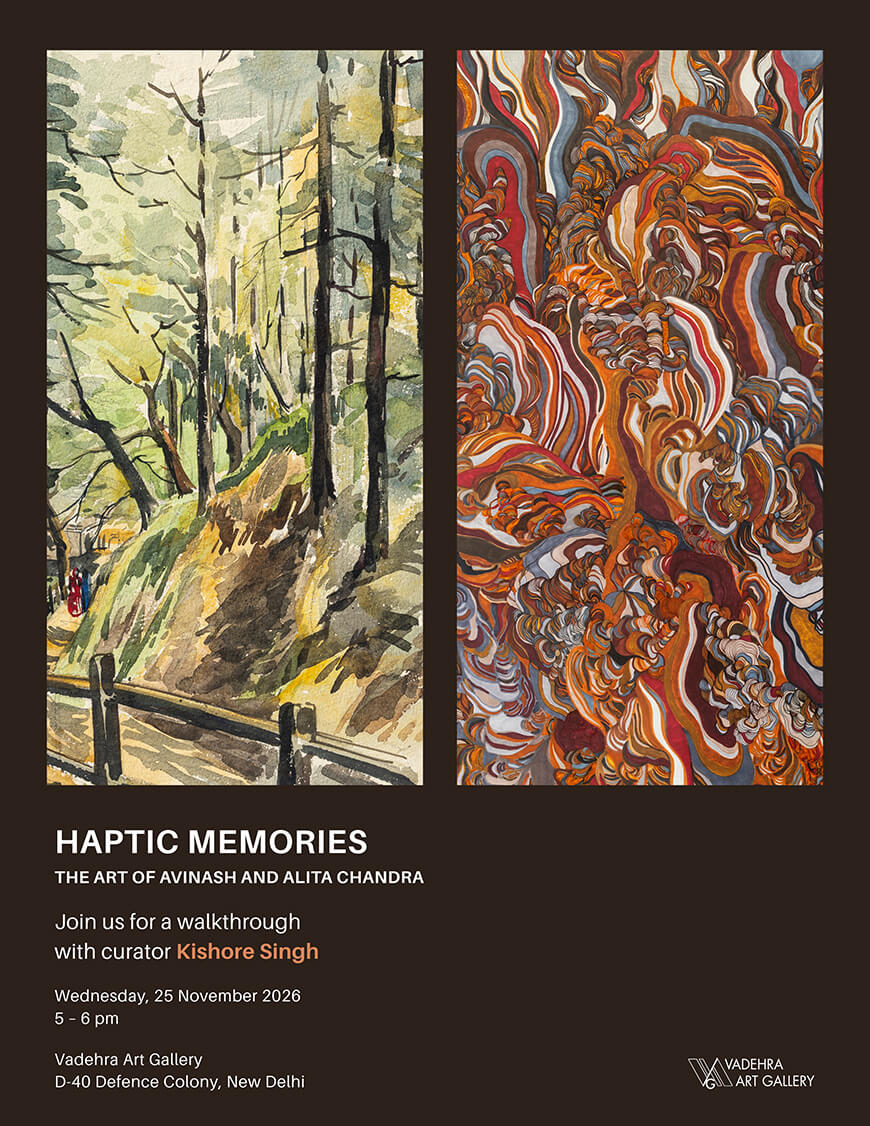
Vadehra Art Gallery presents Haptic Memories: The Art of Avinash and Alita Chandra, a landmark joint exhibition bringing together works on paper by celebrated modern Indian artist Avinash Chandra (1931–1991) and his daughter, contemporary artist Alita Chandra Wig (born 1964). Curated by writer and critic Kishore Singh, the exhibition offers an opportunity to encounter the artistic practices of two generations within a shared space for the first time.
On view from 28 October to 2 December 2026 at Vadehra Art Gallery’s D-40 space in Defence Colony, New Delhi, the exhibition brings together rarely seen landscapes and portraits by Avinash Chandra, drawn from his estate archives, alongside works by Alita Chandra that reveal her distinctive approach to abstraction. Rather than seeking direct similarities between their practices, the exhibition considers the ways artistic sensibilities, memory and inheritance can connect two individuals whose lives and creative journeys unfolded across different generations and geographies.
Avinash Chandra: From Observed Landscapes to Abstraction
Known internationally for his abstract interpretations of Hindu tantric traditions, suburban landscapes and the female body, Avinash Chandra occupies an important place in the history of modern Indian art. Born in Shimla in 1931, he studied at the Delhi Polytechnic Art School, where he later taught before moving to Europe and eventually settling in London.
In Haptic Memories, the artist is represented through a selection of rarely seen early works, including landscapes and portraits from his estate archives. These works feature natural topographies observed in Shimla and Kashmir, alongside watercolours depicting Mughal architectural landmarks in Delhi.
They offer a glimpse into the artist’s engagement with the observed world and the visual sensibilities that would eventually develop into the expansive, intensely chromatic language of abstraction for which he became internationally recognised.
Avinash Chandra was among the first Indian artists to exhibit at Tate Britain in 1965, the same year that Tate acquired his work Two Hills. He was also the first Indian artist to have his work displayed at documenta in Kassel in 1964. His works are held in prominent collections, including Tate, the Victoria and Albert Museum, the Ashmolean Museum and the National Gallery of Modern Art, New Delhi.
Alita Chandra: The Inner World Through Abstraction
Alita Chandra Wig approaches abstraction as a way of exploring human consciousness and the intangible dimensions of experience. Born in London in 1964 and based in New Delhi, she has developed a visual language shaped by her training in design and textiles.
Her works are characterised by fluid lines, chromatic intensity and unconventional forms that extend beyond the boundaries of the canvas. Through an intuitive engagement with line, form and colour, abstraction becomes a means of translating inner experiences into expressive visual structures.
Her practice has been presented through solo exhibitions including Lifelines at Onkaf Gallery, Delhi (2024), Celebrations at Visual Art Gallery, India Habitat Centre (2018), and Glimpses at Shridharani Art Gallery, New Delhi (2016). She has also participated in international group exhibitions and art presentations in New York, Madrid, Milan and Paris.
The Curatorial Perspective: Memory, Distance and Artistic Inheritance
Curated by Kishore Singh, Haptic Memories takes its starting point from the complex relationship between the two artists. Their shared family history did not translate into a shared upbringing or artistic environment. Avinash Chandra’s career flourished in London and New York, while Alita grew up in India, separated from her father’s world and artistic language.
In his curatorial note, Singh reflects on how their respective journeys developed independently, shaped by different circumstances, generations and contexts. The exhibition does not encourage viewers to search for obvious similarities or differences between their artistic vocabularies. Instead, it brings attention to two significant discoveries: Avinash’s previously unseen early works and Alita’s rarely exhibited works.
The title Haptic Memories suggests a form of connection that may not always be consciously understood or directly expressed. It points towards the subtle ways memory, artistic inheritance and creative sensibilities can inform one another across time. Through this presentation, the relationship between father and daughter becomes a point of departure for considering how artistic lineages evolve beyond direct influence or conventional forms of inheritance.
A Shared Space for Two Artistic Journeys
The significance of Haptic Memories lies in bringing together two distinct artistic practices without reducing one to the other. Avinash Chandra’s early observations of landscapes and architectural spaces, and Alita Chandra’s explorations of consciousness through abstraction, offer different ways of approaching the world through art.
By presenting their works together, the exhibition creates a space in which questions of memory, distance, identity and artistic inheritance can be considered through the visual language of two generations.
The exhibition also forms part of Vadehra Art Gallery’s continued engagement with documenting and presenting important artistic practices from the Indian subcontinent and its diaspora. Visitors can experience this first-ever joint presentation until 2 December 2026.
Curator Walkthrough with Kishore Singh
As part of the exhibition programme, Vadehra Art Gallery is hosting a walkthrough with curator Kishore Singh on Wednesday, 25 November 2026, from 5 PM to 6 PM.
The walkthrough offers visitors an opportunity to engage more closely with the exhibition’s curatorial approach and the artistic journeys of Avinash and Alita Chandra. It provides a chance to understand the relationship between the works, the histories behind their presentation and the idea of artistic memory that informs the exhibition.