Review: The 1:30 pm Club – An exhibition of artworks by the Teachers of Painting Department
Painting as Pedagogy: Faculty of Fine Arts Teachers’ Exhibition, Baroda | January 2026
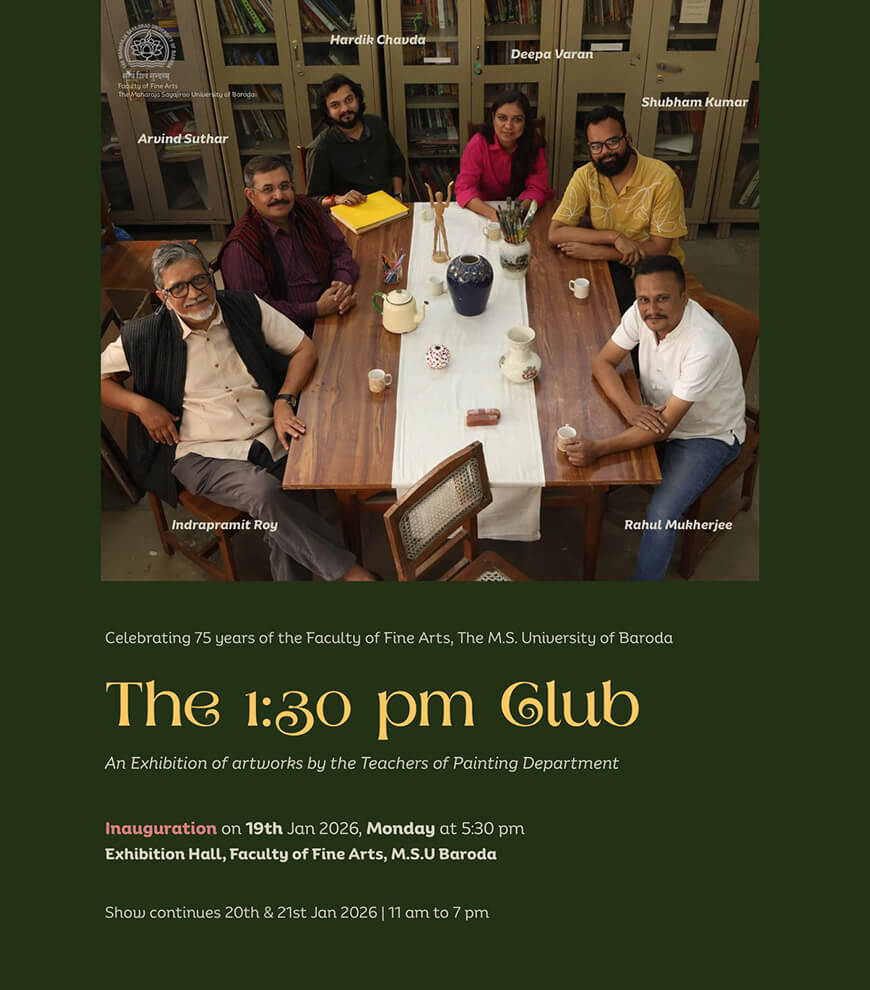
The Painting Department Teachers’ Exhibition, January 2026, at the Faculty of Fine Arts, Maharaja Sayajirao University of Baroda, emerges as a rare and vital moment within India’s contemporary art ecology—where pedagogy and practice converge not as parallel tracks, but as deeply intertwined modes of thinking, making and transmission.
This exhibition brings together the works of practicing artist-educators who have shaped generations of artists while simultaneously sustaining rigorous, evolving individual practices. Often perceived primarily through their institutional roles, these artists reclaim the exhibition space as a site of independent inquiry—foregrounding the studio as both a pedagogical and philosophical arena.
Rather than functioning as a thematic exhibition in the conventional sense, the show unfolds as a constellation of artistic positions, bound together by shared institutional memory, material intelligence and an enduring commitment to reflective practice.
From Classroom to Studio: The Dual Life of the Artist-Teacher
At the heart of this exhibition lies a fundamental question: What does it mean to teach painting while remaining accountable to its contemporary urgencies? The participating artists respond not through didactic statements, but through material decisions—paper, canvas, clay, charcoal, pigment, glaze, memory and time.
The exhibition reflects the lived reality of artist-educators whose practices are shaped as much by sustained inquiry as by daily engagement with students, discourse, critique and experimentation. Teaching here is not represented as instruction alone, but as a continuous exchange, where learning flows in multiple directions.
Indrapramit Roy: The Cloud as Metaphor and Medium
Indrapramit Roy’s body of work, The Drift, meditates on the mutable symbolism of clouds—once poetic carriers of emotion and myth, now entangled with digital infrastructures and invisible data systems. Working with watercolour and dry pastel on handmade Indian paper, Roy constructs images that hover between the atmospheric and the conceptual.
His clouds are neither stable nor singular. They drift between nature and network, memory and illusion, offering a quiet yet incisive reflection on contemporary existence—where perception itself has become fragmented and mediated.
Arvind Suthar: Memory as Material Trace
Arvind Harikrishan Suthar’s works on paper explore perception through abstraction, engaging with phenomenological ideas of memory as fluid, layered and embodied. Charcoal, acrylic, pastel, gold foil and rice paper interact to produce surfaces that oscillate between opacity and translucency.
Rather than presenting resolved images, Suthar’s works operate as fields of emergence, where forms surface, dissolve and reconfigure—mirroring how memory itself resists fixation. The human figure appears only as a latent presence, reinforcing the idea of painting as a temporal experience rather than a representational act.
Rahul Utpal Mukherjee: Roots, Identity and Lived Space
In his Root Series, Rahul Utpal Mukherjee draws from biographical experience, cultural memory and socio-political observation. His mixed-media works examine identity as something embedded within place—shaped by familial histories, social structures and everyday encounters.
Mukherjee’s imagery balances minimalism with symbolic density. His works resist spectacle, instead offering quiet yet potent reflections on belonging, displacement and continuity.
Deepa Varan: Architecture as Memory Structure
Deepa Varan’s practice is rooted in architectural observation—not as static geometry, but as lived, remembered space. Through watercolour, ink and oil on wood, she reconstructs architectural forms from multiple perspectives, layering personal memory with cultural residue.
Elements such as grills, louvers and thresholds recur as metaphors for transition, visibility and containment—suggesting that architecture is not merely built space, but a repository of lived experience.
Hardik Chavada: Material Intelligence and Balance
Hardik Chavada’s ceramic works explore balance as both physical condition and philosophical state. Drawing from Indian cosmological concepts such as Sthitaprajna, his sculptures negotiate stillness, tension and equilibrium.
Clay here is not passive—it resists, responds, transforms through fire. Crystalline glazes, lustre surfaces and structural experimentation position ceramics as a site where tradition, innovation and contemplation coexist.
Shubham Kumar: Home, Conflict, and Fragmented Histories
Shubham Kumar’s works engage deeply with personal and political histories rooted in rural Bihar. His series interrogates the idea of home as both shelter and system—shaped by caste, land ownership and violence.
Using watercolour, image transfer, installation and print, Kumar constructs fragmented narratives where memory and history overlap. His works resist linear storytelling, instead revealing how spaces absorb and echo lived trauma.
An Exhibition as Living Archive
Together, the works presented in the Painting Department Teachers’ Exhibition 2026 form a living archive of contemporary Indian art pedagogy—one that is reflective rather than prescriptive, plural rather than singular.
This exhibition reminds us that the role of the artist-teacher is not to stabilise meaning, but to keep inquiry alive—through material risk, intellectual generosity and sustained engagement with the world.