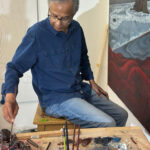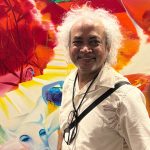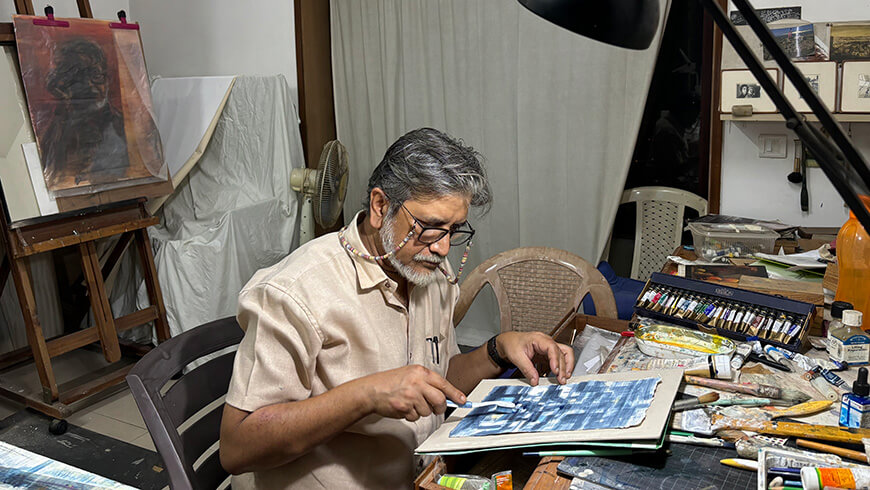
Indrapramit Roy (b. 1964, Kolkata) is a prominent Indian contemporary artist and educator known for his contemplative paintings that explore memory, absence, and spatial intimacy. Trained in printmaking at Visva-Bharati University (Santiniketan) and in painting at M.S. University of Baroda and the Royal College of Art, London, his practice spans a wide range of media such as watercolours, oils, acrylics, pastels and mixed media. His works have been exhibited widely in India and internationally.
Indrapramit has received several prestigious fellowships, including the Inlaks Scholarship, Fulbright Fellowship, Erasmus Exchange grant and some artist residencies. He has been teaching at the Department of Painting, Faculty of Fine Arts, MSU Baroda since 1995. Apart from teaching and his studio practice he writes on art. He lives, teaches, and works in Vadodara, where his art continues to evoke poetic stillness and layered introspection rooted in personal and collective memory.
Harshad Padiya: How would you describe the evolution of your work over the past three decades?
Indrapramit Roy: I am a painter who needs something paintable to begin with. I cannot start with just an idea. To figure that out took a bit of time. I had a very long art education. At home I was always encouraged. My family was very deeply invested in the arts. My father was in theatre all his life. He was an actor and director who additionally edited a seminal theatre journal and wrote on theatre extensively. He also taught drama at an University. My mother was interested in music. Both of them were interested in art. My birthday presents were usually art materials. I was also very fortunate to go to a school, which was an alternative school in Kolkata, where there was a lot of stress on the arts.
After school I joined Santiniketan. That was a five-year course. I specialised in printmaking. Then I came to Baroda and did Masters in painting at MSU followed by a year in Kanoria Art centre, Ahmedabad. Subsequently, I got Inlaks scholarship to study further at the Royal College of Art. Altogether my formal art education itself was a decade long. Once I was done with my formal education, I thought I would become a freelancer.
I moved south to a place called Cholamandal artist village near Chennai. I spent about three years there before I got an offer to teach at MSU. Since 1995, I have been here leading this double life of an art educator as well as a practicing artist. So that is the long and short of it.
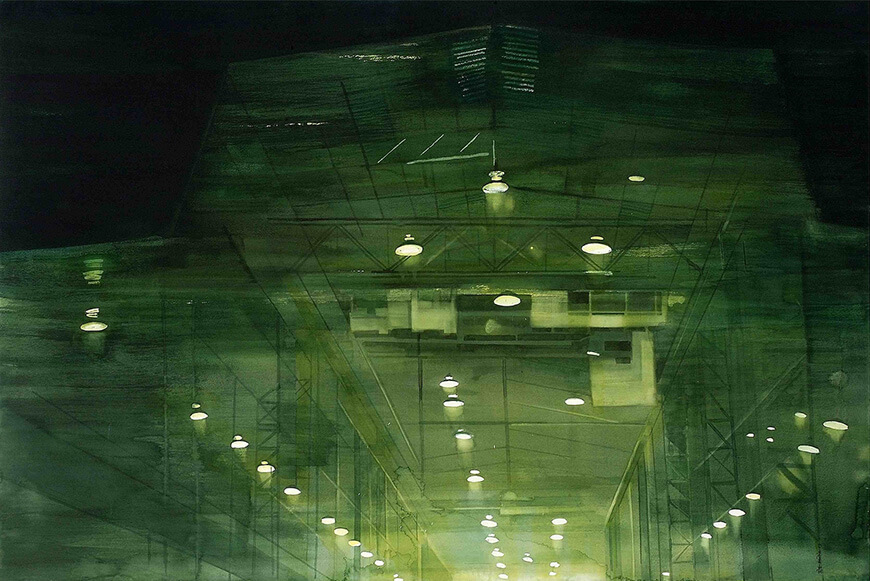
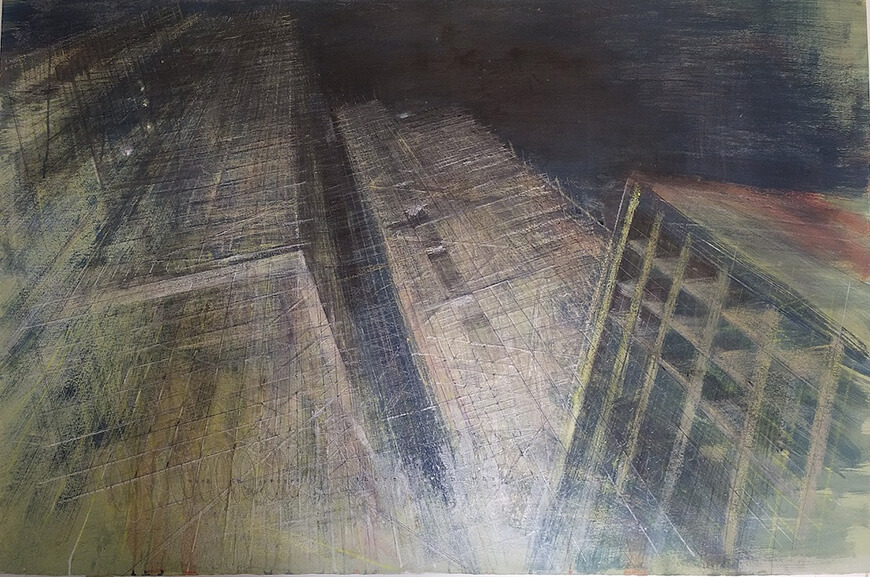
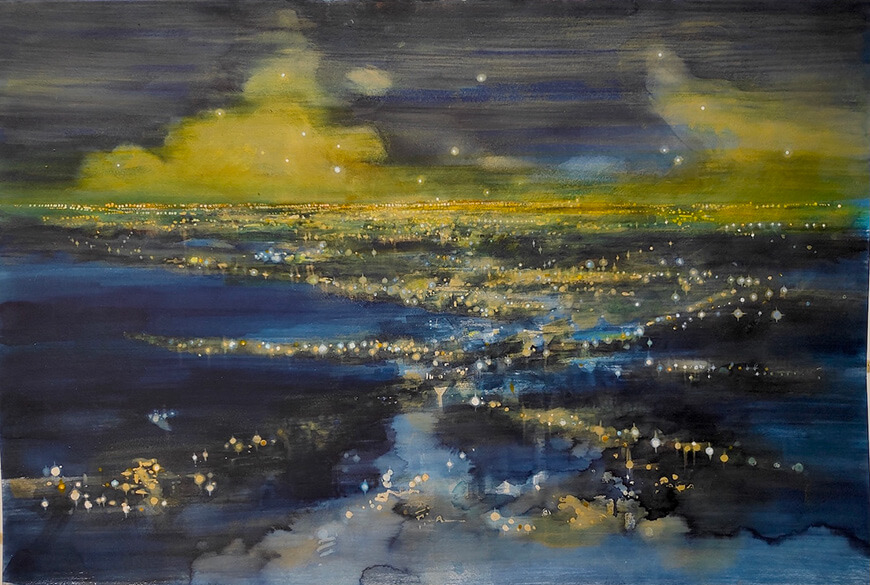
As for my practice, I have always been interested in multiple things other than my main focus, such as theatre, illustration, reading, writing and design. So all those inform my works, I guess. For a long time I have avoided using the human figure in my works, as I feel the empty spaces speak about human presence quite eloquently. For the past two decade I have concentrated a lot on nocturnal urbanscapes but there are always multiple strands in my work. So the evolution is not linear but rather circuitous. Old themes reappear in new avatars regularly.
HP: Your paintings often blur the boundary between abstraction and figuration—how do you arrive at this visual language?
IR: I have always been interested in opposite ends of the spectrum. I do not seek abstraction as a paintable motif is important for me yet the abstraction keeps appearing. I guess at the foundation of every image there is abstraction. They can either be hidden or celebrated. I choose the latter path. But admittedly it is more an inherent tendency rather than a conscious effort.
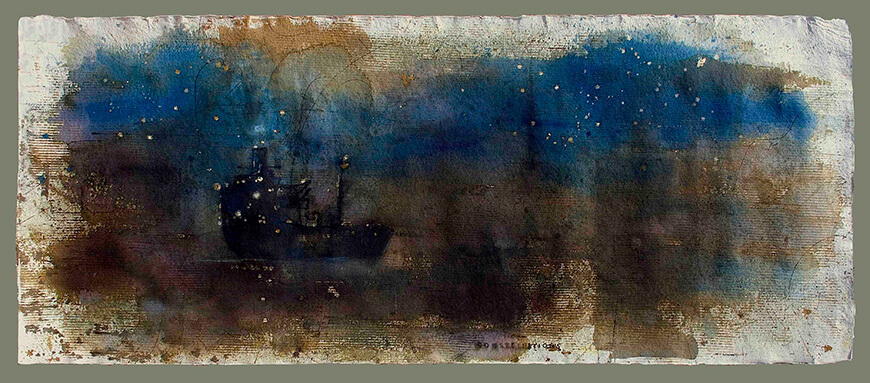
HP: Could you walk us through your typical creative process—from conception to completion?
IR: Sometimes when I look at an image or a thing or a view something triggers in me that tells me this is paintable. Sometimes those images stay with me for years and keep coming back. I do take photos but drawing remains an essential part of my process. They help me to not only respond to the initial impetus but also sort things out, organise and try options. So the drawings often become the key. That is why I always carry a sketchbook. The sketch books can contain drawings, as well as quotations from what I’m reading, stray thoughts and ideas, scraps of found images, rough drafts of some article and many other things. So these are not just sketchbooks but more like ideas books and they are quite chaotic just as my thought process. I am always juggling with multiple things.
Sometimes I start larger works from these notations, sometimes they remain there for years before they appear in my works. So again it is not a neat linear process but rather a chaotic boiling cauldron from where things appear. So there is no one process that can be spoken about in general terms. Each work had its own trajectory from conception to completion. For all I know a theme, an image that I have worked with years ago may just reappear in a changed context and demand a fresh look.
HP: How do memory, time, and the everyday influence your work?
IR: They are three different things. The moment a drawing is made, a photo taken it is consigning things to memory. We are living and constantly making memories every moment. So without memory no art is possible.
Time is an interesting thing and often not just a linear passing of moments in a chronological order. Any work of art aims to somewhat slow your perception of time. The moment you are making an image you are slowing down and that sensation is passed on to the viewer. So even an image of a moment cannot either be seen or done in a moment.
We often assume everyday things are mundane and boring but are they? Mundane things never stop surprising me. Even things that are painted over and over by generations of artists can be seen in a new light. The fundamental thing is the ability to see and show that sense of wonder which leads you to feel that although I might have seen that everyday but never quite seen it like this! That ‘Aha’ moment is all there is to it.
HP: What role does narrative play in your paintings?
IR: By narrative if you mean that there is something else to chew on other than what the visual say on the face value then it does play an important role. The imagery in my work apparently concentrates on the ‘how’ something is painted but there is always a ‘why’ element. The narrative is there, I guess.
HP: Many of your works seem contemplative—do you see painting as a meditative process?
IR: Painting by its very nature slows down time. There are days when you are struggling and it feels like a chore but then magic happens – you lose the sense of time because you are immersed completely. Those are the magical moments that Ken Robinson called ‘when you are in your element’. I think everyone aspires for those moments in their practice when clock time becomes irrelevant.
HP: Are there particular philosophical or literary influences that inform your art?
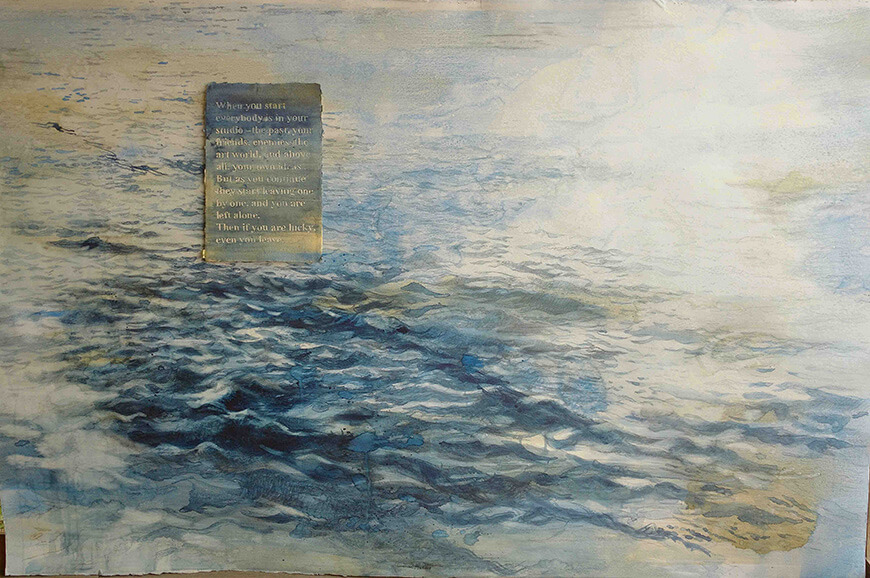
IR: A certain awareness of time passing and that we are here for a limited time. In the bigger picture of the universe and how it works; we are such a miniscule part and I am acutely aware of it. So the transient nature of life, the impermanence of everything actually remain at the core of my consciousness. I cannot help but see the ephemerality of our existence. We live our lives often with petty concerns and miss the big picture. We struggle, we differ, we fight and spoil, we love, we hate, feel important and then one day just vanish. Artists are lucky that they get a chance to make something that might outlive them.
HP: You often work in layers—how does this layering reflect your conceptual concerns?
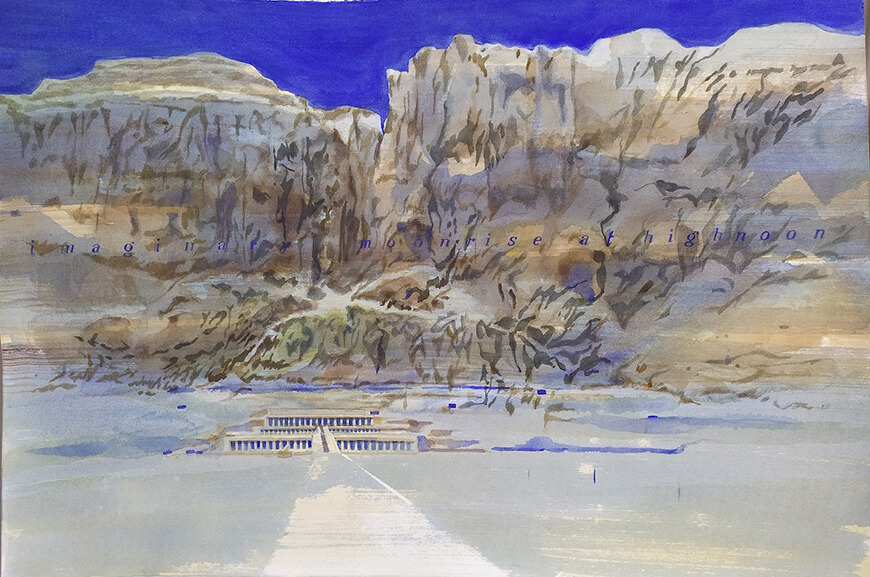
IR: Our experiences are layered and even fractured. In a painting the process of addition and deletion happens, traces of where it started or the path it has taken are important clues that one can either cover up or leave it as it is. I prefer to allow some of those traces to remain and that has now become very much part of the process.
HP: As a professor at M.S. University, how has teaching shaped your artistic sensibility?
IR: Teaching is a creative endeavour. Especially teaching art at a higher level require a personal connect with your students. You are not only teaching but mentoring, hand-holding, counselling and trying to make sure that the person is able to bring out the best in him/her. It takes a tremendous amount of energy but it also allows you to learn from young minds, their questions. So, in some sense it keeps you on your toes, alert and aware. I am in my 30th year of teaching and looking back is gratifying because there is a sense of being able to give back something to the students, the institution. The proximity to a large community of students, ex-students, the artists and art professionals keep you active and agile.
On a deeper level it allows me to observe, to note, to connect and to keep abreast. At the heart of it remains the desire to share. If you have the desire to share your expertise and experience then teaching is for you. I never thought I would be a teacher but looking back I feel I always had the desire to share.
HP: What advice do you give your students about developing a personal voice in their work?
IR: Find your core areas of interest and stay true to yourself. What matters is not the passing trend or fancy but authenticity of your voice. Art is not so much a profession but more a vocation. Once an artist you are always an artist, even when you are sleeping. Don’t mistake skill for artistic ability. You might have great skill but without the passion it does not work. Be aware, be curious and never lose your sense of wonder. Don’t be afraid of failure, they teach you more than ‘success’.
HP: Do you think there’s a shift in how younger artists today approach painting or visual storytelling?
IR: For image making there are many other options now and painting is just one of them. So, those who want to paint, not as a default option but as a choice, have to have some idea about why painting? Painting as a medium is the oldest and survived many ups and downs since 19th C. The fact it is flourishing today tells something about its strength. So an awareness about its strengths and limitations is a good idea. Many find it works for them but then there are others who feel they will work better in another medium, perhaps with moving images or photography or a multidisciplinary practice. All are welcome provided the choice is made on the basis of the demand of the work and not just because it is trendy.
HP: How has the Indian art landscape changed since you began your career?
IR: Quite a lot. It has opened up to many more possibilities. It is not as inward looking. The economics and technology has changed quite radically. Online platforms allow artists to reach out directly to an audience bypassing the gate keepers.
It is possible now for some young artist to survive as an artist without taking recourse to a day job. In some sense it is better than even some countries in the global north. The good thing is we have not lost all connection with the past and that is the strength of the Indian art scene not its weakness.
On the negative side there has been increasing cases of censorship and surveillance by a moral brigade that has political patronage. They find artists and other creative people as easy targets. That is a bad sign for any country. If artists cannot question and have to self-censor their works out of fear of reprisal then all is certainly not well.
Hurting of sentiments – is exceedingly used as a ruse that can be effectively manipulated to ban a large chunk of art or literature. Artists definitely have a social responsibility and part of that is to question taboos and conventional wisdom. What art is meant to do is to hold up a mirror that might reflect something uncomfortable. Ideally the responsibility of the civil society is to stand up and say –‘I may not agree or even like what the artist has done but he has a right to do it.’ But as things stand now that does feel like a tall order.
HP: Do you think Indian contemporary art gets its due on global platforms?
IR: The situation is a lot better than before but global platforms come with their own dynamics that are not always beneficial because the terms are often imposed from outside. Besides, the global platforms also have their economic logic that translate into a different kind of hegemony. The narrative as well as the purse strings are still, to a large extent, in the hands of a few in the developed world, despite all this talk of globalisation. So it is mixed blessing but definitely there is a lot more of those platforms now available than before and that is a good thing, as it should be. I am just saying it can be a mixed blessing, one must not hanker for it or judge an artist simply by those bench marks.
HP: What keeps you inspired and committed to painting after so many years?
IR: A sense of wonder and discovery. The ability to be surprised with simple things. If I cannot paint for a stretch of time I start getting restless and a feeling of being unwell starts creeping in. So, I guess it isa mixture of these things.
IR: Are there any collaborations, exhibitions, or projects you’re excited about in the near future?
IR: Yes, something is brewing but I am not going to talk about it now.
HP: If not a painter, what other form of creative expression might you have pursued?
IR: I always knew I wanted to be an artist but of course what kind of artist I had no clue. I was good with a few things, you might want to call it a flair. I could have been a reasonably good actor, puppeteer, stage designer or illustrator, alternatively a historian or perhaps a creative writer. Some of the things I get to dabble in by virtue of being an artist. Had I not been teaching perhaps, I would have explored them more but I am already in two very demanding professions and I have never regretted my choice.
Baroda, 25 August 2025.