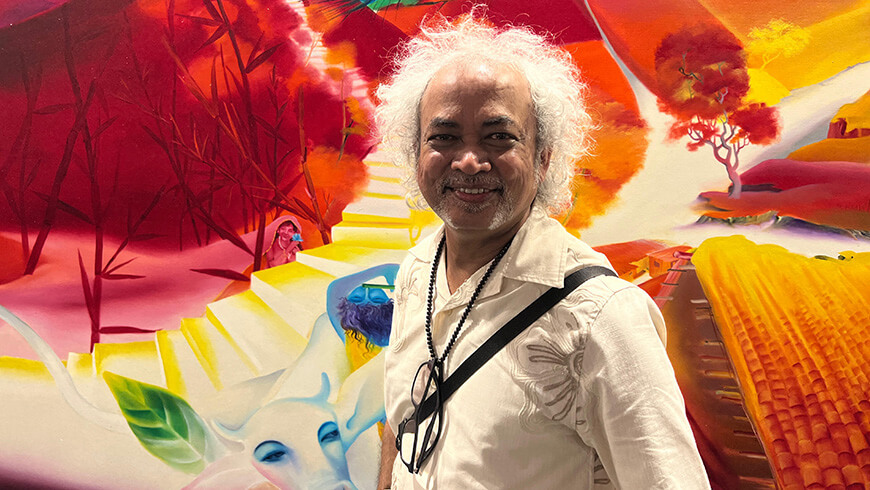
Born in 1966, Nabibakhsh Mansoori hails from Oda — a quiet village nestled in the Sabarkantha district of Gujarat — where his childhood bloomed amidst open skies, folk stories, and the rugged beauty of the Aravalli hills. He completed his Diploma in Fine Arts from Sheth C. N. College, Ahmedabad (1990), followed by a Post Diploma in Creative Painting from M.S. University of Baroda (1992).
Recipient of the prestigious Bendre-Husain Scholarship (1999) and Ministry of Culture Fellowship (1995–97), Mansoori has held 29 solo exhibitions globally and participated in numerous art camps and workshops across India. In 2002–03, he collaborated with legendary artist M. F. Husain during the making of Amdavad Ni Gufa. His works have been featured in prominent auctions by Christie’s, Bonhams, Sotheby’s, and AstaGuru.
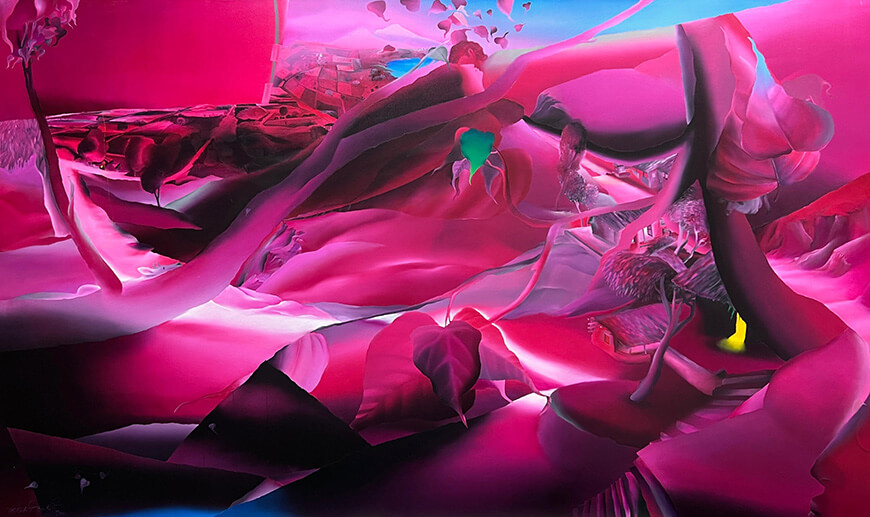
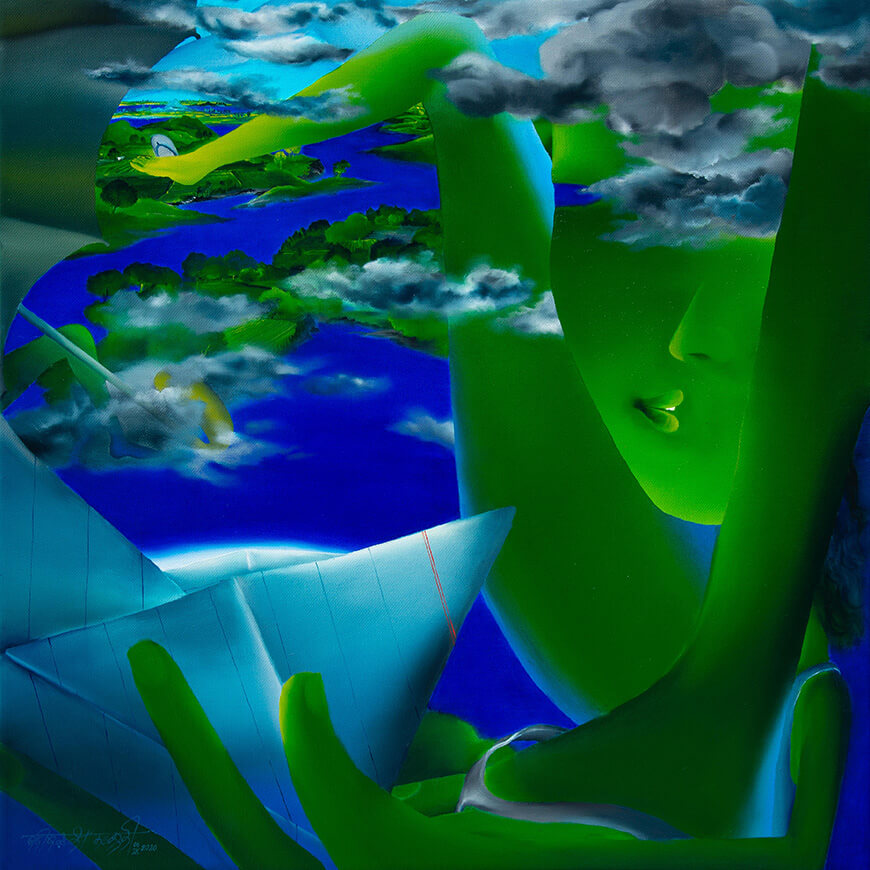
Drawing inspiration from folk traditions like Bhavai Vesh, oral epics, and vivid childhood memories, Mansoori’s paintings balance between dream and memory, often rendered in surreal hues. A masterful colorist, he blends the real and the fantastical with poetic ease.
He currently lives and works in Gandhinagar, Gujarat.
Harshad Padiya: When did you first discover fine art and how did you decide that it was what you wanted to pursue professionally?
Nabibakhsh Mansoori: As a child, I would spend hours drawing and sketching — it was my secret world of joy. When I was in 7th standard, my creative talent was recognized by those closest to me: my parents, my uncle Ami Chacha, and our dear family friend Amrutbhai Patel, a drawing teacher. Their appreciation gave me my first wings.
Later, in 11th standard, my high school principal and drawing teacher, Rameshbhai Soni, encouraged me to pursue fine arts seriously.
After I failed my 12th standard exams — an event many might see as a setback — I found my true direction. I enrolled at Sheth C. N. College of Fine Arts and completed my Diploma. Later, at M. S. University of Baroda, my years at the Faculty of Fine Arts deepened my conviction. What began as a hobby gradually transformed into a lifelong calling.
HP: Who and what inspire you?
NM: Nature has been my constant muse since childhood — especially the mountains of Idar, where I often wandered in solitude.
During my studies in Ahmedabad, I was fortunate to learn under respected teachers like Urmiben Parikh, Ajit Desai, and K. R. Yadav. At the Faculty in Baroda, I found inspiration in
the guidance of Gulam Mohammed Sheikh, Jyoti Bhatt, and Vinod Shah. Artists like Bhupen Khakhar and K. G. Subramanyan often visited the campus — their presence was electric, and their conversations unforgettable.
The time I spent with M. F. Husain remains especially close to my heart. His fearless spirit
and generosity gave me confidence — not just to paint, but to believe.
HP: How do you select the materials for your artworks?
NM: To me, materials are like instruments — the music depends on the mood. I let the concept guide the medium.
Nature’s vibrancy — its colours, rhythms, and contrasts — has always fascinated me. That’s why I love working with watercolours, where transparency feels like breath. Oil colours, on the other hand, offer depth and richness that feel self-fulfilling.
If a concept demands sculpture or another form, I would embrace that as well. The creative impulse always comes first — the medium follows.
HP: How do you come up with ideas for artwork?
NM: For me, expression matters more than ideas. I often carry a sense of nostalgia — of places, voices, seasons, and smells — which quietly flows into my work.
Where I have lived, the cultures I’ve absorbed, and the fables I’ve heard — all find subtle expression in my paintings. Series like In Search of Rainbow, Twilight, and Mirage were born this way.
One of nature’s most powerful creatures, the tiger, frequently appears in my canvases — a tribute to the awe and wonder I felt as a child. My recent series, Camouflage, is another response to nature’s poetic intelligence.
Moving Malls of India emerged from my observations of local hawkers — mobile storytellers of Indian life. For me, painting is an emotional act — not an intellectual one.
HP: How has your artistic practice evolved since you began painting?
NM: In the early years of art school, I was immersed in learning academic foundations — drawing, technique, composition. At M.S.U., I deepened my skills through rigorous sketching, which still underpins my visual language.
I came to understand the importance of riyaz — daily practice — just as essential in visual art as in music or dance. Over time, I noticed that a spiritual undercurrent began to emerge in my work, reflecting an inner need.
My compositions now breathe more freely. They’re no longer bound by strict technique but guided by feeling.
HP: What do you believe is a key element in creating a good composition?
NM: There’s no fixed formula for me. Sometimes, it’s contrast in colour; other times, spatial balance, linear perspective, or even figure distortion.
I believe good composition arises organically — when the elements serve the emotion behind the work.
HP: Does your practice of drawing improve your painting? Or vice versa?
NM: Drawing is a foundation, yes — but I believe it’s how you perceive life that truly shapes your work.
I often discuss my compositions and ideas with well-wishers — that exchange sharpens me. But at the core, it’s about feeling. Drawing serves painting, and painting refines perception.
HP: Do you use any unusual equipment or techniques in your creative process?
NM: Not really. I prefer simplicity. The paintbrush is my lifelong companion. I don’t indulge in excessive technicality — I let the brush do what it must.
The process should feel natural — not forced.
HP: How do you know when a piece is finished?
NM: In truth, no artwork ever feels “complete.” Each piece adds something to the next. But when I feel I’ve said what I needed to — emotionally — I sign the work. That signature is my way of smiling at the canvas.
HP: Have you ever made a painting you didn’t want to sell?
NM: Many times. Every painting is like a child — letting go is never easy. And if I feel too attached, I quietly hide it away.
HP: Which contemporary artists inspire you?
NM: As always, nature is my foremost inspiration. But among artists, M. F. Husain has been a guiding light — his life, his resilience, and his fearless creativity continue to inspire me. Despite his global stature, Husain Saab remained grounded. His warmth, humour, and humility are rare in the art world. I carry those memories with deep gratitude.
HP: What has been the most challenging part of your life?
NM: Articulating my thoughts in words. I find it difficult to explain what I feel. That’s why I paint — it’s my language.
HP: What advice would you give to young, aspiring artists starting out in their career?
NM: I would say — stay in love with the act of creating. Not with fame, not with trends. Just the simple joy of making something with your hands, your heart, your breath.
In today’s world, anyone can call anything art. But art that endures comes from silence, observation, and patience. Don’t be in a hurry to arrive — instead, take your time to truly see, truly feel.
Learn your fundamentals like a musician learns their notes — sketch, draw, repeat. That’s your daily riyaz. Without that inner discipline, even the wildest imagination remains vague.
Also, don’t be afraid of new mediums — but enter them with depth and sincerity, not for novelty’s sake. Let your ideas flow naturally into whichever form they choose — be it canvas, sculpture, film, or even sound.
And most importantly — don’t paint to impress; paint to express. If your work carries truth, it will find its home.
Art is not a competition. It is a quiet companionship with yourself. The more honest you are with your inner world, the more beautifully you will connect with the outer one.
HP: Describe your studio environment. What helps you focus?
NM: Since childhood, I’ve loved the company of birds and animals. My studio is an extension of that affection.
I’ve installed glass sliders to let light and nature in. Birds come and go — I feed them, listen to their songs as I paint. I’ve created a small garden of my favourite plants, especially cacti. A 20-foot-high pencil stands as a whimsical monument within the studio — a reminder of childlike joy.
The scent of linseed oil, distant neem and mango trees, soulful music, birdsong, and the soft clatter of brushes — this is my world. Days become nights here, and I lose count of time.
HP: Is there a painting that holds special meaning for you?
NM: Many. I remember selling just one painting on the last day of my first solo show — it felt like both defeat and beginning.
One of my works shown at Rajshri Cinema in Gandhinagar led to my meeting with M. F. Husain. After my father’s death, I painted Kaagvaas — a deeply personal piece. It was once acquired by a London gallery; I recently brought it back into my personal collection.
HP: If you could collaborate with any artist from history, who would it be?
NM: Without a doubt — M. F. Husain. And I was lucky enough to do so.
While working with him on Amdavad Ni Gufa, I painted a massive dome guided by a small charcoal sketch he had drawn. The experience — climbing bamboo platforms, drawing on large surfaces — was unforgettable.
It was more than collaboration. It was a blessing.
HP: Who are your favourite artists?
NM: I’ve admired many — Marc Chagall, August Macke, Salvador Dalí, Henri Matisse, Henri Rousseau, Rene Magritte, and Picasso for their magic and vision.
Among Indian artists: M. F. Husain, Tyeb Mehta, Bhupen Khakhar, and Gulam Mohammed Sheikh continue to fascinate and inspire me.