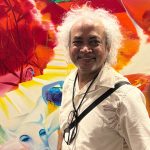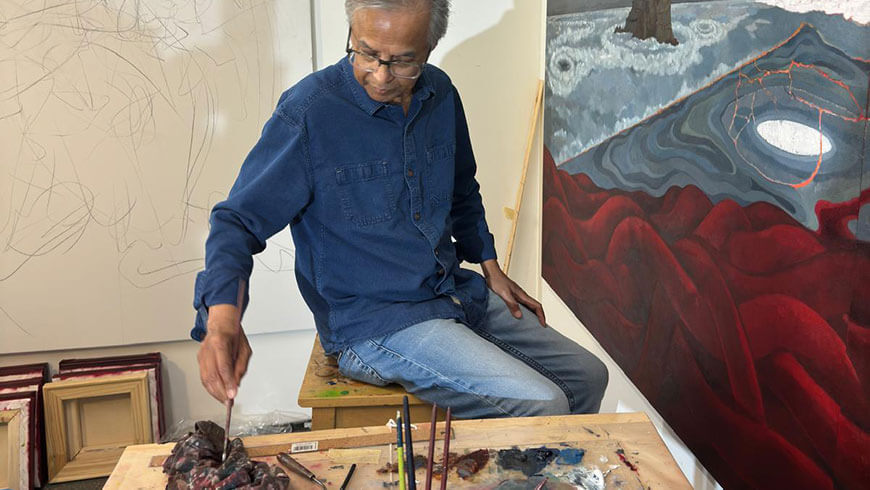
Sajal Sarkar is an artist of the Indian diaspora who explored most of the conventional mediums like drawing and painting, printmaking, and sculpture. Completed his BFA in Drawing and Painting in Govt. College of Art and Craft, The University of Calcutta in 1989, and then studied Printmaking at the Faculty of Fine Arts, Maharaja Sayajirao University of Baroda, India. In 1993-95.
He has won several grants and awards, including the New Jersey State Council on the Arts Individual Artist Fellowship in 2024, The Adolph and Esther Gottlieb Foundation grant in 2021, Senior Research Fellowship from the Cultural Ministry of India in 2011-12. The Elizabeth Greenshields Foundation, Canada, in 1996 and 2005.
Sajal has shown his work in numerous solo shows and group shows in various parts of the world.
In 2016, he migrated to the USA and continued his art practice, exploring various natural mediums in his work. Sajal presented several artist talks, including at the University of Connecticut (UConn), CT, the World University of Design, Haryana, India, Maharaja Sayajirao University of Baroda, India, and East Connecticut State University.
His interview was published in Art Review City, New York, and Art Soul Life magazine in India, and an article was published in Art India Magazine. His works are in the collection of the Kiran Nadar Museum of Art, New Delhi, Library of Congress, DC, National Gallery of Modern Art, and Lalit Kala Academy, New Delhi, along with several private collections internationally.
Sajal presently lives and works in NJ
Studio: MANA Contemporary, Jersey City
Website: www.sajalnsarkar.com
Email: sajalsr@gmail.com
Harshad Padiya: Tell us about your early years in India and how they influenced your entry into the arts.
Sajal Sarkar: I was born and raised in Kolkata, a city deeply rooted in its cultural and political heritage. Growing up during a period of significant political unrest shaped my consciousness early on. The charged atmosphere—both socially and visually—pushed me to engage with the world through art. My formal journey began with a BFA in Drawing and Painting at the Government College of Art and Craft, Calcutta University, where I was introduced to conventional techniques. And later develop my concept through interaction with the senior artists.
HP: What initially drew you to printmaking, and how did that foundation shape your later work?
SS: My time at the Faculty of Fine Arts, Maharaja Sayajirao University of Baroda, where I studied printmaking, was transformative. I was drawn to the discipline of the medium—the layering, the physicality, the rhythm of process. Printmaking taught me to think conceptually and technically. These qualities stayed with me even as I transitioned into more experimental media. It built a foundation of inquiry and sensitivity that continues to inform my entire practice.
HP: How did migrating to the US in 2016 affect your artistic practice and worldview?
SS: The move marked a rupture—both existential and creative. Uprooted from familiar cultural and visual frameworks, I entered a period of disorientation that ultimately gave rise to new questions. I began to shed the dominance of figuration that had defined much of my earlier work. Various forms emerged not just as a formal choice, but as a language to explore loss, belonging, and transformation. The psychological depth of migration profoundly influenced the spiritual and conceptual turn in my recent work.
HP: Your work reflects strong socio-political engagement. How do you balance the personal and the political in your art?
SS: For me, they are intertwined. I come from a region shaped by partition, migration, and ideological struggle—those legacies live within me. My work doesn’t deliver political messages; rather, it offers spaces for reflection. The personal lens makes the political more intimate, while the political gives the personal broader resonance. My concern is always with the human spirit—its fragility and resilience in times of crisis.
HP: What subjects continue to haunt or inspire you?
SS: I am drawn to the raw edges of human existence—loss of identity, the wounds of suffering, the inevitability of mortality, and the ache of spiritual dislocation. The collapse of civilizations, whether through war, forced displacement, or the slow violence of environmental breakdown, is not just a backdrop but an active force shaping my creative life. I confront the silence around suffering, that resistant void where words fail, yet abstraction can pierce through. These themes do not leave me; they return, transformed, demanding new forms, new materials, new vocabularies. Love and sexuality—ancient forces that bind and break us—emerge as vital undercurrents, echoing the mythologies that have carried human longing and conflict through centuries.
HP: How do issues of migration and belonging appear in your visual language?
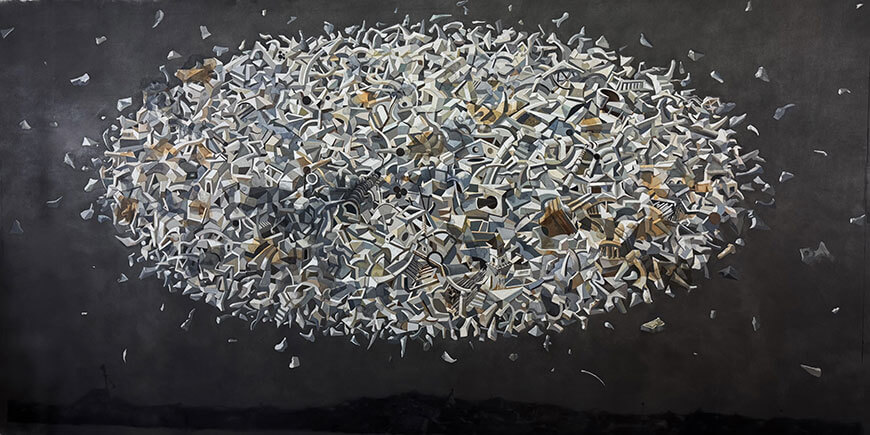
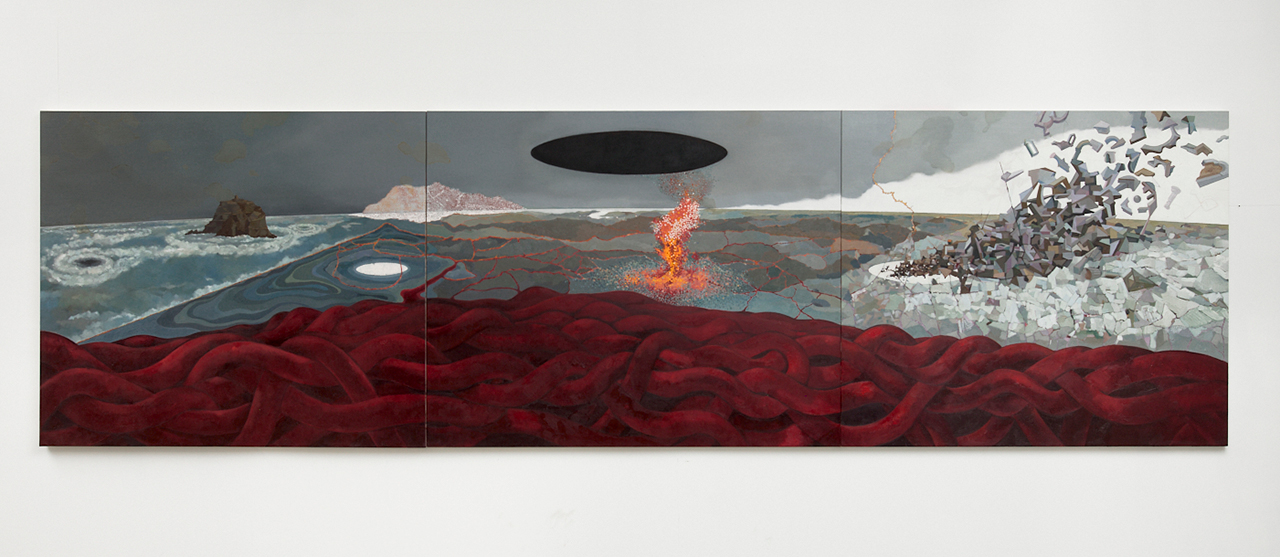
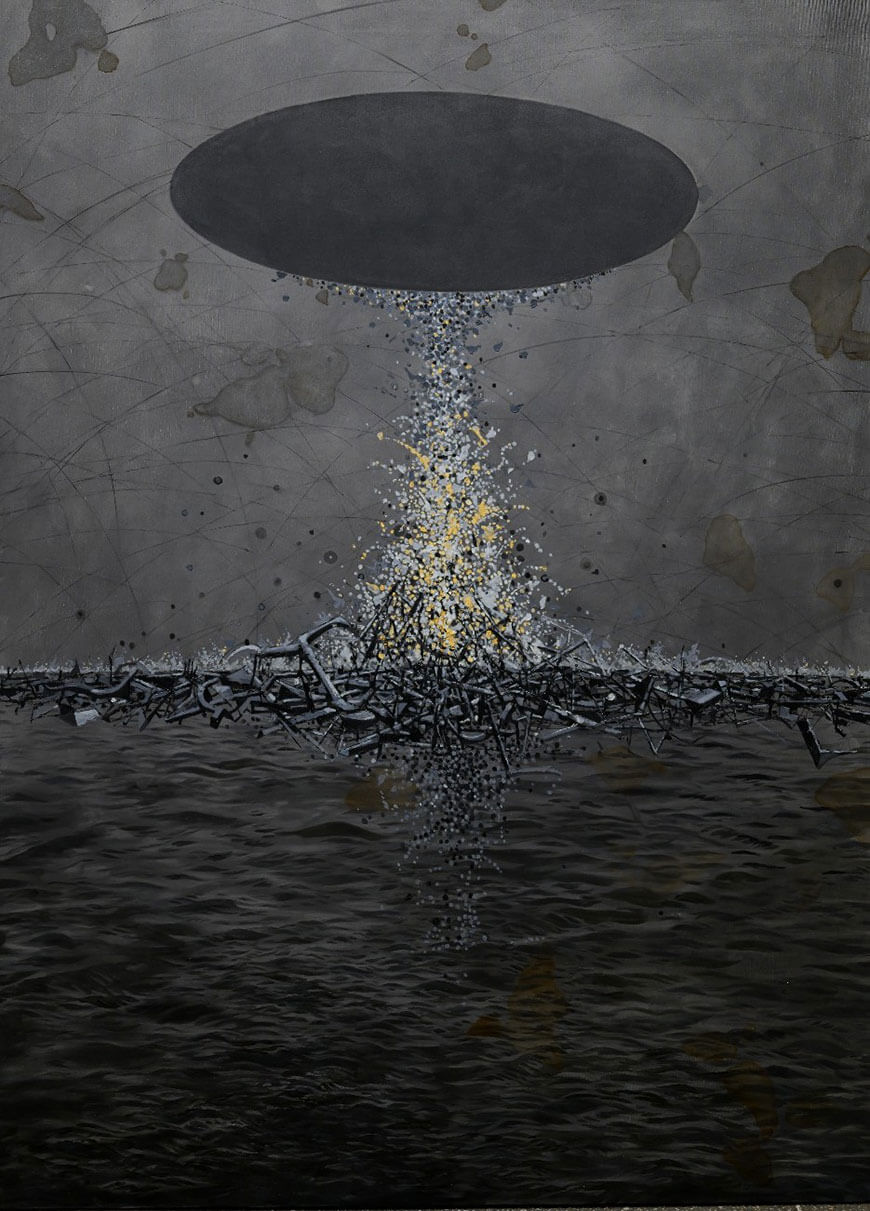
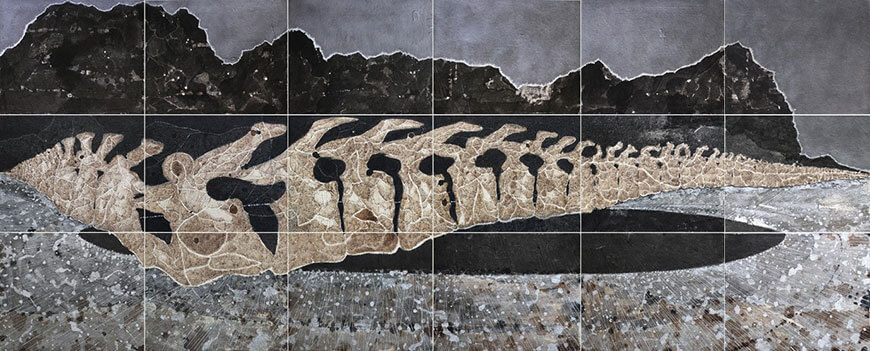
SS: My work unfolds through contextual abstraction, drawing on lived experience, quantum philosophy, Indian spirituality, and mythology to explore fragmentation, impermanence, and the fluidity of identity. The elliptical form, a recurring symbol, evokes both the black hole—absorbing and transcending materiality and a spiritual cycle of dissolution and renewal. Responding to rising authoritarianism and the politicization of identity, I reimagine “home” as emotional, historical, and constructed rather than geographic—a space of mourning and possibility where the displaced self can reflect, grieve, and rebuild.
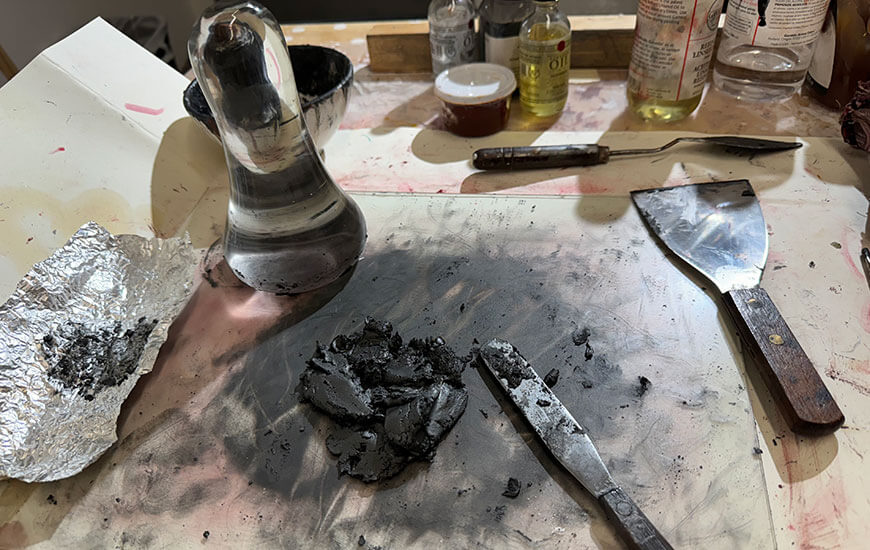
Since moving to the U.S., my artistic practice has evolved with greater intention and freedom. While my early training in conventional drawing, painting, printmaking, and sculpture provided a strong foundation, continuing some of these mediums—particularly printmaking and sculpture—has been challenging here. However, the resources and environment in the U.S. have opened new possibilities for experimentation with materials like graphite powder, marble dust, and natural pigments, often combined with oil and watercolor on a larger scale. I create my own colors and delve deeply into researching pigments, glues, and solvents, which has led to unexpected and exciting results. Exposure to American contemporary art and its vibrant museum culture has helped me break old habits and embrace a more intuitive, responsive process. This shift has drawn me toward a form of abstract realism, where material and form arise from emotional and conceptual resonance—an ongoing evolution that continues to inspire and challenge my work.
HP: Do you consider drawing a complete practice or a tool for exploration?
SS: Both. Drawing remains the most immediate and most honest form of expression for me. It serves as a space for exploration, but often becomes the final work itself. My foundation in drawing supports everything I do, whether in painting, printmaking, or sculptural experiments. It’s a way to think and feel through the hand.
HP: Do you see yourself positioned differently in the global art discourse now compared to when you were based in India?
SS: Yes, significantly. In India, my work was often contextualized within a figurative tradition and socio-political commentary rooted in local histories. In the US, I’ve had to reframe those narratives and build a more universal language. This shift has expanded my visual vocabulary and helped me connect with broader concerns—environmental collapse, identity, displacement—while still retaining a deep connection to my roots.
HP: How do you maintain a connection with Indian art and its evolving landscape?
SS: I keep in close touch with the Indian art scene through regular visits, talks, publications, and conversations with peers. I’ve given lectures at institutions like Maharaja Sayajirao University of Baroda and World University of Designs, Haryana, and I remain actively engaged with Indian contemporary artists, writers, historians and curators. While my practice is now situated globally, the philosophical and cultural foundations of Indian art continue to inspire and shape my vision.
HP: How do you approach presenting work to an audience, especially one unfamiliar with your cultural references?
SS: I approach it with sensitivity and openness. I often allow the materials, forms, and emotions within the work to initiate a dialogue, even when cultural references are unfamiliar. I don’t try to explain everything—instead, I let viewers find personal meanings. At times, I share insights through artist talks or wall texts to gently guide interpretation. I believe strong work can transcend boundaries, and emotional truths can resonate universally. I welcome curiosity and leave space for multiple readings.
HP: What keeps you rooted to making art after all these years?
SS: Art remains my way of engaging with life—emotionally, intellectually, and spiritually. It allows me to process inner conflict, societal tension, and metaphysical curiosity. Even when the outer world feels uncertain, the act of creating gives me direction. My process has become meditative and investigative over time, and it continually renews itself. What keeps me rooted is the mystery—that I never fully know where a piece is going until it unfolds. That search keeps me going.
HP: Do you ever revisit or rework older pieces or themes?
SS: Yes, quite often. I revisit older ideas when they feel unfinished or when they gain new relevance in light of current contexts. Sometimes it’s not a literal reworking of a piece but returning to its essence with a new visual vocabulary. Certain symbols, shapes, and emotional states reappear—transformed. The elliptical shape, for instance, has morphed in meaning for me over the years. Repetition becomes a way of deepening rather than merely reusing.
HP: What role does silence or introspection play in your creative process?
SS: Silence is essential. It allows the subconscious to surface. My process begins not with ideas, but with stillness—listening to materials, to space, to the residue of memory. I don’t rush into work with a fixed image. Instead, I engage in long periods of contemplation. This introspection becomes especially important when dealing with subjects like human suffering or cultural displacement, where nuance matters. Silence helps reveal what words cannot.
HP: What are you currently working on, and are there any new directions you’re excited to explore?
SS: Unpredictability guides my process. I begin from an empty state, letting forms and ideas surface as if the work itself were remembering. In a world living and dying amid the rubble of collapsing civilizations, I search for the fragile soul of humanity. Along with conventional mediums which is readily available, I incorporate graphite powder, marble dust, and natural pigments—they carry their own histories, shaping the work as much as I do. Recently, I’ve embraced unexpected forms emerging from debris out of my imagination, allowing the process to unfold organically. Each piece becomes an excavation—where matter and philosophy meet to reveal the restless spirit of our time.