In the holy town of Nathdwara, nestled in the Aravalli hills of Rajasthan, art and devotion converge to create a living tradition that has thrived for over four centuries: the Pichhvai painting. Rooted deeply in the Pushtimarg sect of Vaishnavism, these intricate cloth paintings serve not merely as decoration but as seva—offerings to the deity Shrinathji, a child form of Lord Krishna.
A History Woven in Faith
The origins of Pichhvai painting trace back to 1409 AD, when the idol of Shrinathji—Krishna lifting Mount Govardhan—was first discovered in Mathura. As Mughal threats loomed, the idol was relocated in 1671 AD to a safer refuge offered by Maharana Raj Singh of Mewar. When the bullock cart carrying the deity stopped moving near present-day Nathdwara, it was decided that the temple would be established right there. Nathdwara—Nath (Lord) and Dwara (Gate)—literally became “The Gateway to the Lord.”
The entire spiritual and economic life of Nathdwara began to revolve around this temple, including the flourishing of a distinct painting style: the Nathdwara school of miniature painting, a subset of the Mewar tradition.
What is a Pichhvai?
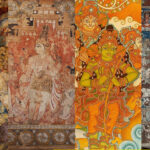
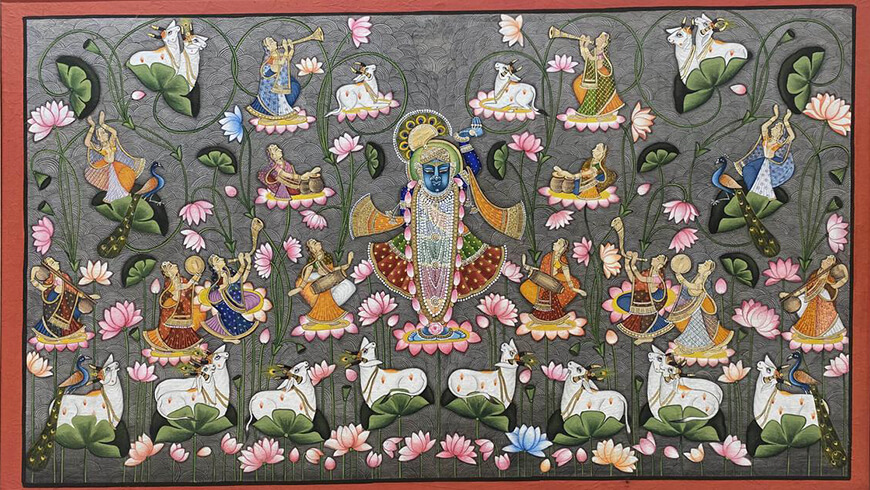
Derived from pichh (back) and vai (hanging), Pichhvai paintings are large fabric scrolls that form the backdrop behind the idol of Shrinathji in the temple. But beyond being visual adornments, they function as sacred storytelling tools—narrating the divine lilas (plays) of Krishna, his interactions with the Gopis, and the celebration of various festivals.
Each Pichhvai is an act of devotion, meticulously painted by hand and often crafted collaboratively by groups of artists. With large expressive eyes, robust forms, and exquisite ornamentation, the figure of Shrinathji is often depicted as a princely child, adorned in rich silks, pearls, and zardozi embroidery.
Seasons, Festivals, and the Divine Calendar
Pichhvais change with the rhythms of the seasons and the Hindu calendar:
- Summer: Lotus motifs in pinks and pastels cool the visual aura.
- Winter: Intricate jamawar designs simulate warmth.
- Sharad Purnima: Night scenes illuminated by the full moon.
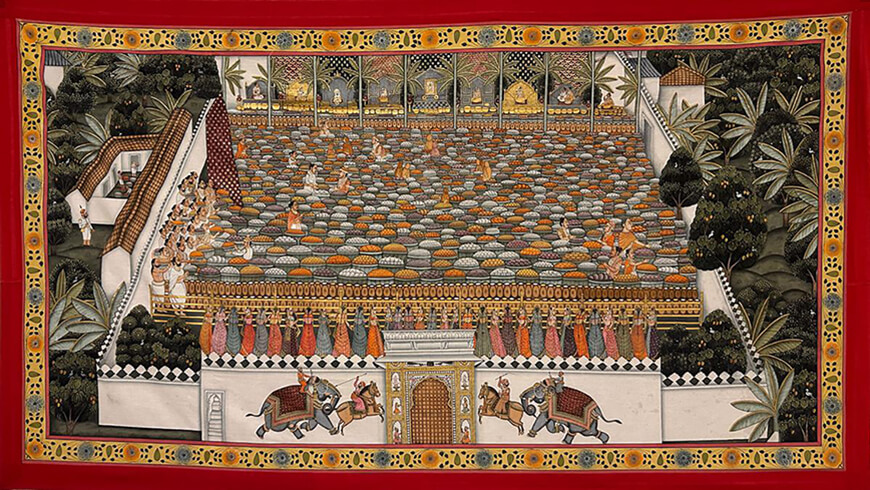
- Annakut (Govardhan Puja): A magnificent depiction of Shrinathji in silver attire, adorned with dabka and gotapatti embroidery.
Techniques & Traditions
Traditionally painted on starched handspun cloth, artists begin with a rough sketch, gradually filling in the forms using natural pigments, and sometimes even pure gold. Preparing gold pigment alone may take 3–4 days. Brushes were historically made from squirrel, goat, or horse hair.
The finest Pichhvais still rely on traditional methods. The styles vary:
- Painted
- Hand-block printed
- Embroidered (appliqué, gota work)
- Woven or appliquéd on velvet
Colors are rich and symbolic—reds, blacks, indigos—and gold thread is used to highlight the divine radiance of Shrinathji.
The Street of Painters
In Chitaron ki Gali (The Street of Painters), families of artists have practiced this art for generations. A single Pichhvai can take weeks or months, with master artists guiding a team. Paintings are made for temple commissions, but smaller versions are sold to pilgrims to carry home as devotional keepsakes—especially since photography inside the temple is strictly prohibited.
During temple Darshan (sacred viewing), when the doors open with the boom of drums and trumpets, thousands gather for a glimpse of their lord. And always, behind Shrinathji, a Pichhvai glows—framing the divine presence.
Nathdwara’s Living Legacy
Nathdwara may lie in Rajasthan, but its spiritual atmosphere feels closer to Mathura, with its Awadhi dialects, sweet shops selling rabri and kachoris, and streets humming with devotion and enterprise.
The Pichhvai tradition remains not just an art form, but a living cultural economy: sustaining livelihoods, preserving rituals, and visually narrating centuries of faith.
In the town where Shrinathji is both Lord and King, the Pichhvai is not just a backdrop—it is the unfolding sentence of divine love, paused mid-verse, still in motion.