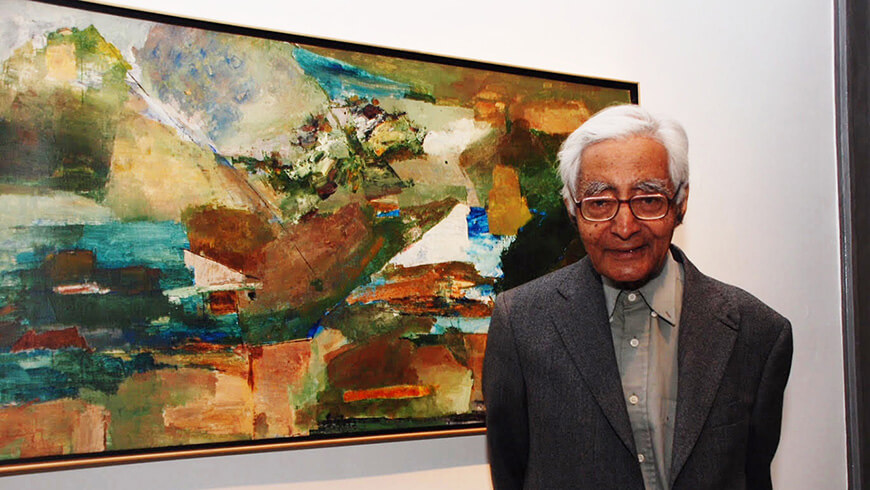
Ram Kumar (1924–2018) was a master of silence, solitude, and spiritual resonance on canvas. A seminal figure in India’s modern art movement, he began as a figurative painter and evolved into one of the earliest Indian artists to embrace pure abstraction. His work—rooted in emotion rather than form—mirrors a quiet inner landscape shaped by reflection, poetry, and post-Independence existential inquiry.
Early Life and Training
Born in Shimla in 1924, Ram Kumar studied economics at St. Stephen’s College, Delhi. His passion for art led him to the Sharda Ukil School of Art and later to Paris, where he trained under André Lhote and Fernand Léger. It was during this European sojourn that he was introduced to Expressionism and abstraction—forms that deeply resonated with his internal world.
The Shift from Figurative to Abstract
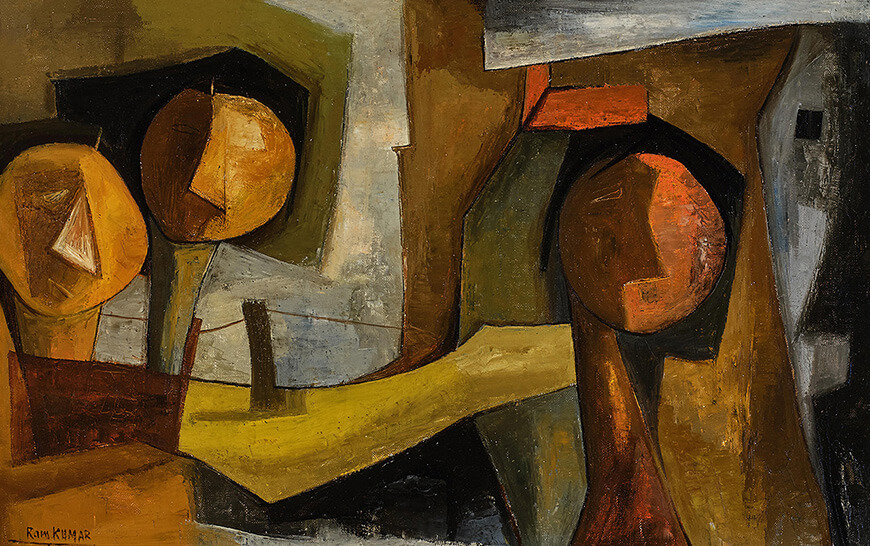
Ram Kumar’s early works were filled with social commentary—urban life, alienation, and human struggle. But gradually, his figures disappeared, replaced by brooding, abstract landscapes. These forms—often interpreted as metaphysical cities or crumbling civilizations—expressed a sense of stillness, introspection, and emotional depth rarely found in Indian art at the time.
His palette, dominated by earthy ochres, deep blues, and greys, reflected not nature as it is, but as it is felt—moody, distant, and hauntingly beautiful.
Banaras – A Turning Point
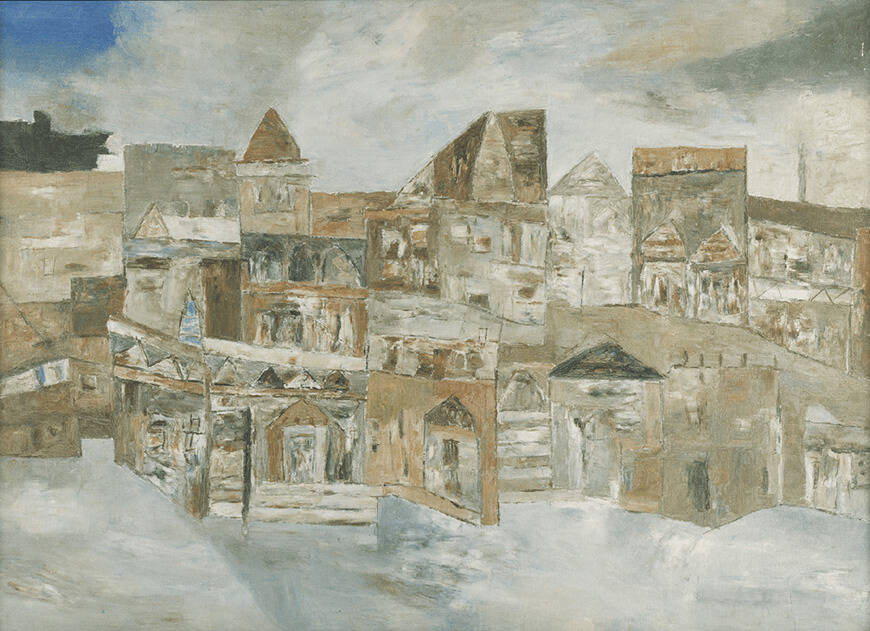
His visits to Banaras in the 1950s marked a major transition in his artistic language. The city’s timeless melancholy and decaying beauty found deep resonance in his work. His Banaras series is widely considered a landmark in Indian modern art—where cityscape became emotion, and structure dissolved into soul.
Ram Kumar and Indian Modernism
Along with contemporaries like MF Husain, SH Raza, Tyeb Mehta, and Krishen Khanna, Ram Kumar was a part of the Delhi Shilpi Chakra and shared an early connection with the Progressive Artists’ Group. However, his quiet temperament and philosophical nature set him apart. His works are contemplative, internal, and poetic—more meditative than dramatic.
Beyond the Canvas – Ram Kumar the Writer
A lesser-known but equally profound part of Ram Kumar’s legacy lies in his Hindi short stories and travelogues. His writing reflects the same melancholy and existential depth found in his paintings—probing the human condition with sparse, lyrical precision.
Legacy and Recognition
- Padma Shri (1972) and Padma Bhushan (2010)
- Represented India in several international exhibitions including São Paulo and Venice Biennales
- His works are in major collections such as NGMA, MoMA (New York), and the Lalit Kala Akademi
Even today, Ram Kumar’s paintings remain deeply evocative. They don’t shout—they resonate. They are not descriptions—they are meditations.
Conclusion
Ram Kumar’s art was not about the seen, but the sensed. His contribution to Indian modernism lies not just in style but in substance—in bringing the inner life to the surface. For anyone seeking silence in an increasingly noisy world, Ram Kumar’s art offers refuge—a silent language of emotional depth and transcendence.
“Painting is the silence of thought and the music of sight.”
– Ram Kumar