Across India, Diwali—known as the festival of lights—has been celebrated for centuries as a symbol of renewal, triumph, and joy. But beyond the rituals and festivities, the festival has also found a luminous place in Indian visual culture, particularly in miniature painting traditions that flourished between the 16th and 19th centuries.
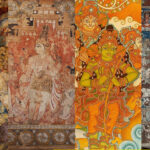
Through delicate brushwork, vibrant pigments, and gold-leaf embellishments, Indian miniature paintings captured the essence of Diwali—not merely as a religious event, but as a poetic expression of light, abundance, and human emotion. From the Mughal ateliers to Rajput courts, from Pahari valleys to Deccan kingdoms, artists used Diwali as a moment to celebrate both divine radiance and worldly splendor.
Light, Devotion, and the Miniature Aesthetic
In miniature paintings, light is rarely literal—it is symbolic. Artists used gold leaf, burnished highlights, and subtle tonal contrasts to evoke the luminosity of Diwali lamps (diyas). These depictions often blend mythological, devotional, and courtly narratives, reminding us that Diwali was as much about spiritual awakening as it was about celebration.
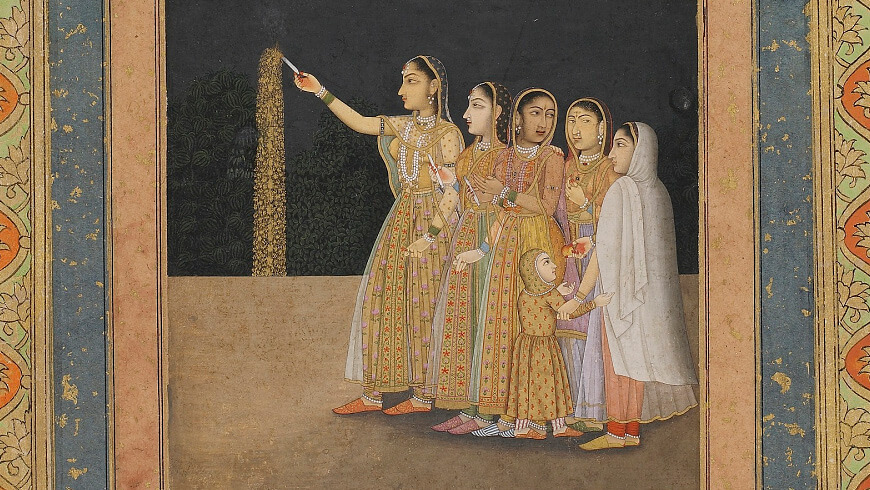
For example, Rajput painters from Kishangarh, Bundi, and Jaipur schools frequently illustrated scenes of Diwali within palace courtyards. Women are shown lighting rows of oil lamps along marble terraces; courtiers exchange gifts and sweets; musicians perform while the night sky glows with fireworks. Each brushstroke transforms light into devotion—every flicker of a lamp, a metaphor for the human soul seeking divine illumination.
Myth and Memory: The Return of Rama
In the Ramayana, Diwali marks the return of Lord Rama to Ayodhya after defeating Ravana. This theme became central to many Mewar and Kangra miniatures, which depict Ayodhya aglow with light as citizens welcome their exiled king.
In one 18th-century Mewar miniature, the entire city is depicted in rhythmic geometry—terraces stacked with thousands of tiny flames. The artist renders each diya as a glowing halo, creating a shimmering tapestry of devotion. Rama and Sita appear at the center, not as distant deities, but as embodiments of cosmic balance restored.
Such paintings transform mythology into memory, bridging the sacred and the everyday. The joy of Rama’s return becomes symbolic of the return of light, justice, and order into the world—a universal message transcending religious boundaries.
Mughal and Deccan Depictions: Courtly Splendor and Symbolism
While the Mughal emperors were not Hindu, their ateliers frequently produced Diwali-related imagery as part of broader depictions of Indian festivals. Under Emperor Akbar, the Mughal court adopted an inclusive aesthetic—artists painted Jashn-e-Chiraghan (Festival of Lights) celebrations, where nobles and musicians gathered under starlit skies.
In the Deccan Sultanates, artists of Bijapur and Ahmadnagar integrated Persian sensibilities with Indian themes. Their depictions of Diwali scenes carry a dreamlike quality—terraces lit by lamps, courtesans in jewel-toned garments, and attendants preparing sweets. Here, light becomes a metaphor for cultural fusion—the blending of Persian elegance and Indian intimacy.
Pahari Miniatures: Spiritual Light and Inner Illumination
In contrast to the grandeur of courtly scenes, Pahari painters from Kangra and Guler approached Diwali with lyrical delicacy. Their works often show Radha and Krishna celebrating Sharad Purnima or Kartik Purnima, festivals linked to Diwali’s cycle of light.
The glowing moon mirrors the light of the lamps; the divine lovers stand in soft illumination, surrounded by musicians and gopis. The emphasis here is on bhakti (devotion)—the internal illumination of love, rather than external spectacle. These paintings are less about the act of lighting lamps, and more about awakening the light within.
The Language of Light: Materials and Techniques
Artists working in miniature painting traditions had to translate the flickering, ephemeral quality of Diwali into permanent pigment. They achieved this through a mastery of technique—applying gold leaf to highlight flames, layering mineral pigments to create depth, and burnishing the surface to make it gleam.
In many surviving examples, real gold was used for lamps and ornaments, giving the painting a reflective quality when viewed under light—almost as if the artwork itself were alive with illumination.
This visual language of light transformed the Diwali scene from documentation into transcendence—a meditation on impermanence, beauty, and inner radiance.
Modern Resonances and Legacy
Even as miniature traditions declined with colonial modernity, the imagery of Diwali continued to inspire artists of the modern and contemporary era. Painters like Jamini Roy, K. K. Hebbar, and M. F. Husain referenced festival themes to explore the play of color, light, and emotion in new ways.
Today, Diwali imagery persists in digital art, printmaking, and installation works, but its roots trace back to those intimate, meticulously painted miniatures—each one a silent song of devotion.
As we look at these centuries-old images, we find not just decorative art, but profound reflections on human celebration—the universal longing for light amidst darkness, and joy amidst transience.
The depiction of Diwali in Indian miniature paintings stands as a testament to the country’s artistic synthesis of devotion and aesthetics. Whether in the glow of gold leaf or the softness of natural pigment, these works capture an enduring truth: that light, both literal and spiritual, is central to human experience.
To look at them today is to be reminded that Diwali is not just a festival—it is a philosophy, an act of remembering the light that lives within us all.