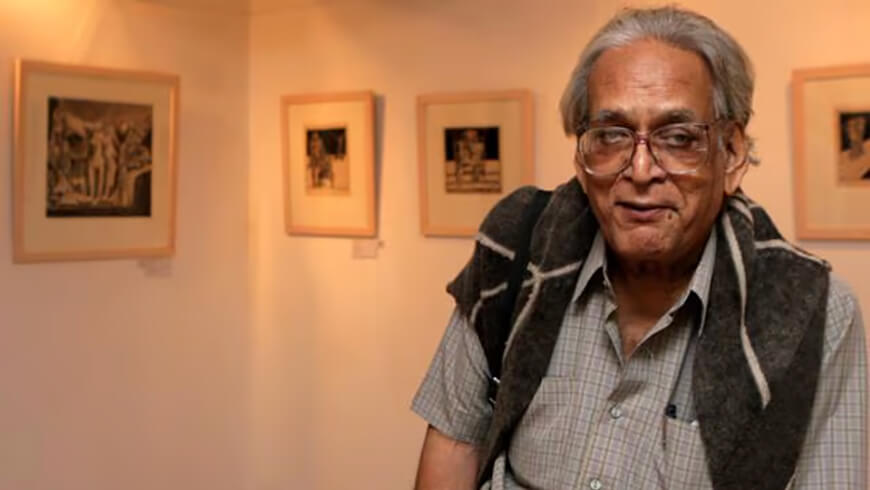
In the ever-evolving narrative of modern Indian art, few figures have been as defiantly original and quietly radical as Jeram Patel. A name often evoked in the same breath as masters like Tyeb Mehta, M.F. Husain, or S.H. Raza, Patel’s work carved a distinct path—one forged in flame, abstraction, and introspection. This is a tribute to the artist who not only created art but challenged its very boundaries.
Early Life and Formation
Born in 1930 in Kheda, Gujarat, Jeram Patel’s early influences were shaped by a deeply rooted sense of Indian culture and a growing curiosity about form and material. He studied at the J.J. School of Art in Mumbai and later went to the Central School of Art in London, where his exposure to Western modernism deeply influenced his formal language.
While many of his contemporaries adopted figuration or narrative-based styles, Patel turned toward abstraction, seeking to express internal emotional landscapes rather than external reality. His work often bypassed decorative appeal in favor of stark materiality, rigorous form, and conceptual depth.
The Language of Fire
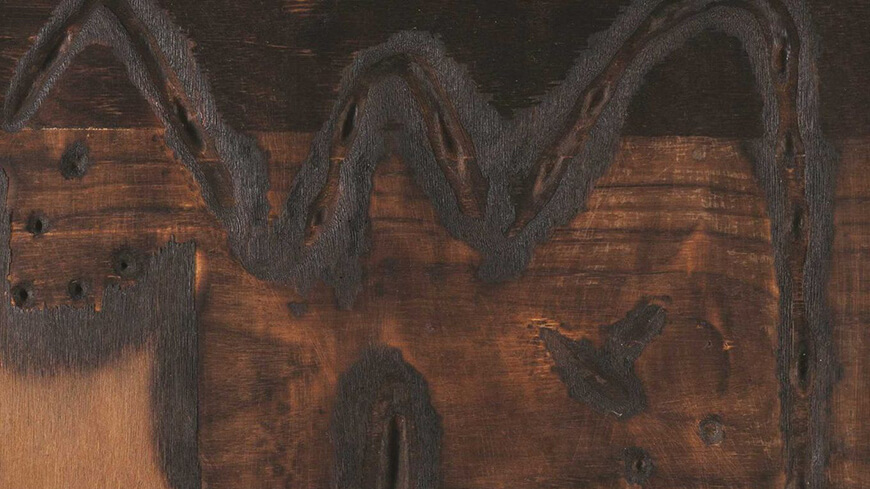
What set Jeram Patel apart from his peers was his use of an unconventional and daring technique—the blowtorch. Inspired by Japanese methods of burning wood, Patel used a blowtorch on plywood to char, scorch, and etch the surface. This brutal yet meditative process created bold black surfaces carved with lines and textures that felt both primeval and futuristic.
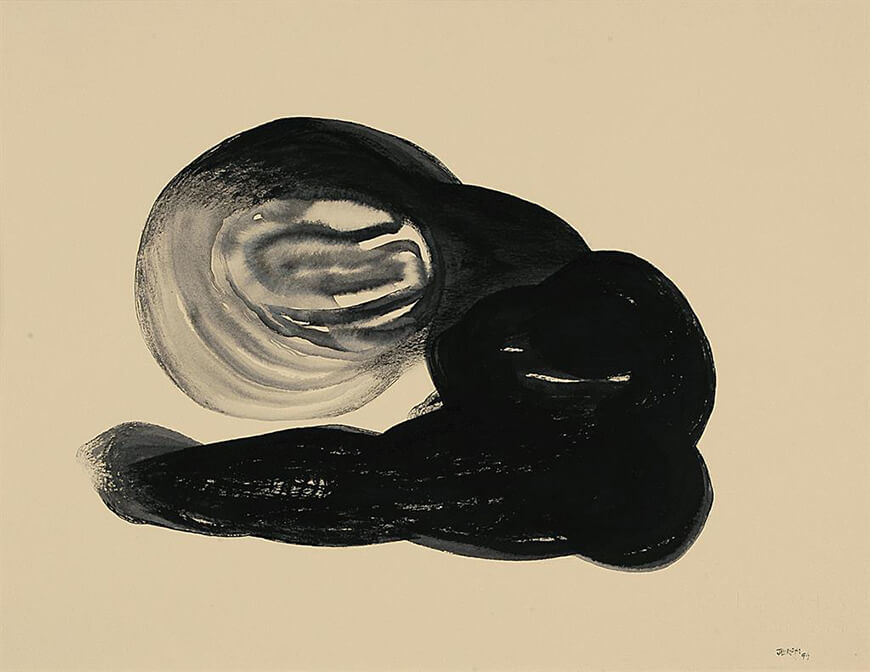
These burnt wood compositions were not simply exercises in destruction, but acts of transformation. The fire became a tool of creation, where darkness revealed depth and voids became vessels for meaning. Over time, he began incorporating ink, gouache, and mixed media, but his allegiance to abstraction and material experimentation remained consistent.
Group 1890 and the Break from Tradition
Jeram Patel was a founding member of Group 1890, a short-lived but significant collective of modern Indian artists that sought to break away from academic realism and the Bengal School’s nationalist aesthetics. Their 1963 manifesto, written by Hungarian critic György Kepes, was a call for a new, post-colonial modernism rooted in individual exploration rather than historical nostalgia.
Although the group disbanded soon after its first exhibition, its impact on Indian modernism was considerable—and Patel’s work exemplified its ideals. He became a beacon for artists who wanted to move beyond tradition without rejecting cultural memory.
A Teacher and a Recluse
Patel spent much of his professional life teaching at the Faculty of Fine Arts, M.S. University of Baroda, one of India’s most prominent art institutions. He was known to be a demanding yet deeply inspiring teacher—one who urged students to look within and think critically about form, medium, and meaning.
Despite his influence and stature, Patel remained somewhat reclusive. He never sought the spotlight and was more interested in the intensity of process than in public acclaim. He preferred the quiet of his studio, the resistance of the plywood, and the transformative dialogue between fire and surface.
Legacy and Influence
Jeram Patel passed away on January 18, 2016, but his legacy continues to burn with relevance. His works are held in major collections including the National Gallery of Modern Art and private institutions across India. Exhibitions like “The Dark Loam” at Kiran Nadar Museum of Art have brought renewed attention to his pioneering role in Indian abstraction.
In an era where art is increasingly consumed, shared, and forgotten in a click, Patel’s art demands presence. It asks us to pause, to engage with density and silence, to enter a space where form is not just seen but felt. His oeuvre stands as a tactile archive of modernist dissent—where material is meaning, and fire is philosophy.
Through his uncompromising practice, Jeram Patel left behind more than just artworks—he left behind a language of artistic integrity, rooted in risk, rigor, and reflection. In honoring him, we honor the very act of making art that resists easy resolution.