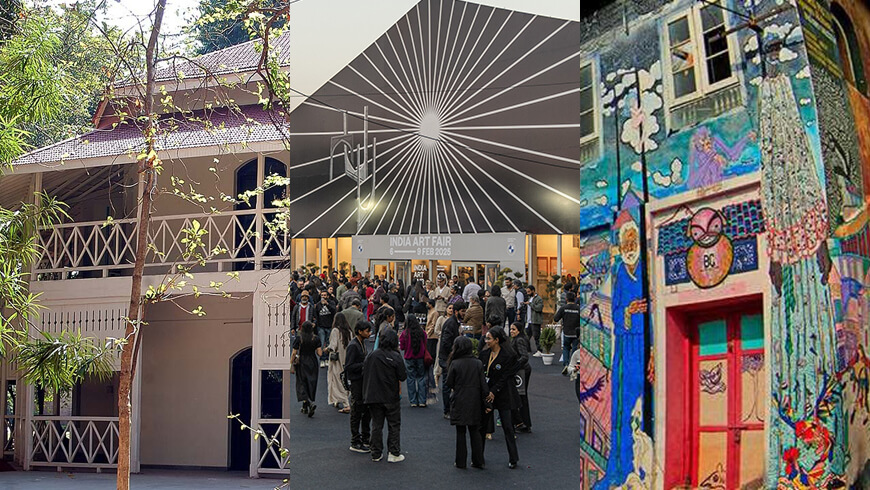
India’s contemporary art landscape is not defined by a single tradition or geography. Instead, it thrives through a network of cities—each contributing distinct energies, communities, and histories. Among these, three cities stand out as foundational ecosystems shaping the country’s artistic imagination: Baroda, Delhi, and Kochi. Together, they form a dynamic triangle of pedagogy, market, and experimentation.
Baroda: The Studio as a Thinking Space
Baroda (Vadodara) has long been recognized as a cradle of Indian modern and contemporary art. The Faculty of Fine Arts, Maharaja Sayajirao University (MSU), established in 1949, continues to nurture generations of artists who engage deeply with form, politics, and material. Unlike metropolitan art hubs, Baroda’s ecosystem is built on intimacy—studios, hostels, and informal addas where ideas move freely.
The “Baroda School” is not a stylistic category but a culture of inquiry. It draws from the legacies of Jyoti Bhatt, K.G. Subramanyan, Gulammohammed Sheikh, Nasreen Mohamedi, and Bhupen Khakhar—artists who bridged tradition with experimentation. Today, younger artists continue to expand these conversations through printmaking, installation, performance, textiles, and socially engaged practices.
Baroda’s art ecosystem is sustained through collective energy: shared studios, artist-led spaces, bookshops, and cross-disciplinary discussions. Even without a large commercial gallery network, Baroda remains a powerful intellectual force—its students shape art discourse across India and abroad.
Delhi: The Market, Museums, and Modern Institutions
If Baroda is the classroom, Delhi is the corridor through which art enters public consciousness. As India’s capital, Delhi hosts a vibrant market ecosystem, supported by institutions such as:
- National Gallery of Modern Art (NGMA)
- Kiran Nadar Museum of Art (KNMA)
- Indira Gandhi National Centre for the Arts (IGNCA)
- Art Fair circuits and significant gallery districts
Delhi’s galleries—Vadehra Art Gallery, Nature Morte, Shrine Empire, Gallery Espace, Latitude 28—play a pivotal role in representing artists globally. They connect Indian art to biennales, residencies, and auctions, shaping its market and international reception.
The city is a meeting ground for artists, curators, critics, and collectors. Studio practices in areas like Lado Sarai and Aya Nagar reflect a diverse ecology—ranging from conceptual installations to political art addressing identity, gender, caste, and ecological crisis.
Where Baroda provides depth, Delhi provides visibility. It is a place where ideas become exhibitions, where careers take shape, and where contemporary Indian art enters global conversations.
Kochi: Experiments by the Sea
Kochi changed the conversation around art in India with the arrival of the Kochi-Muziris Biennale in 2012. What began as an artist-led initiative has evolved into South Asia’s largest contemporary art festival. The Biennale transformed Kochi into a global laboratory of experimentation—where abandoned factories, warehouses, and heritage buildings become immersive exhibition spaces.
The Biennale’s significance lies not only in its international scale but in its democratic, inclusive, and experimental spirit. It introduced new forms of engagement:
- Community-based and socially grounded art
- Large-scale installations and site-specific works
- Dialogues that merge regional histories with global politics
- Public programs, workshops, art education, and performances
Kochi’s art ecosystem thrives on collaboration—between artists, local communities, writers, students, and visitors. It is a space where new voices find visibility and where experimental practices gain cultural legitimacy.
Three Cities, Three Energies
Baroda, Delhi, and Kochi represent three different but interconnected energies within contemporary Indian art:
- Baroda: Thought, pedagogy, experimentation
- Delhi: Market, institutions, visibility
- Kochi: Public engagement, innovation, global dialogue
Together, they shape the ecosystem through which Indian contemporary art evolves. Baroda provides the studio; Delhi provides the stage; Kochi provides the transformation. These cities may differ in geography and culture, but they share a common commitment—to sustain art that responds to society, history, and the present moment.
The future of Indian contemporary art will continue to emerge from this intersection of learning, showcasing, and reimagining—a triangulation that keeps the field vibrant, challenging, and deeply alive.